

Have you noticed that contactors for industrial equipment control mainly fall into two categories: mechanical electromagnetic contactors and solid-state contactors (SSC)?
Electromagnetic contactors are widely adopted in industrial control and can be easily seen in various distribution boxes. Most people are quite familiar with them, yet know little about solid-state contactors.
Therefore, in this blog post, we’ll take an in-depth look at solid-state contactors. You will learn:
- What a solid-state contactor is
- How it works
- Its key advantages
- Common application scenarios
- Main types and selection guidelines
What are solid-state contactors?


Solid-state contactors, also known as solid-state relays, allow us to control high-voltage and relatively dangerous power using low-voltage and safe signals; they are distinctly different from conventional electromagnetic contactors.
Electromagnetic contactors consist of coils, springs, and mechanical contacts, relying on electromagnetic force to close and open physical contacts. This operating principle inevitably leads to contact arcing, operating noise, and mechanical wear, resulting in a relatively limited lifespan.
In contrast, solid-state contactors have no moving mechanical parts. They use semiconductors, optocouplers, and thyristors to achieve switching.
Solid-state contactors feature arc-free operation, quiet operation, and zero contact wear, making them ideal for high-frequency and frequent start-stop applications.
How does a solid-state contactor work?
We all know that a physical switch closes an open circuit to form a closed loop, allowing current to flow and supply power to a load for specific tasks such as heating, lighting, or driving a water pump. As mentioned earlier, solid-state contactors have no mechanical contacts – so how do they achieve the same switching function as traditional physical switches?
The secret lies in their core semiconductor components: thyristors and MOSFETs.
The working principle of a solid-state contactor is straightforward. When a low-power control signal is input, the internal optocoupler provides electrical isolation first, then triggers the thyristor or MOSFET to turn on. This enables the main circuit to conduct current without any mechanical movement.
When the control signal is removed, the semiconductor component switches off automatically, instantly disconnecting the main circuit.
Key advantages of solid-state contactors
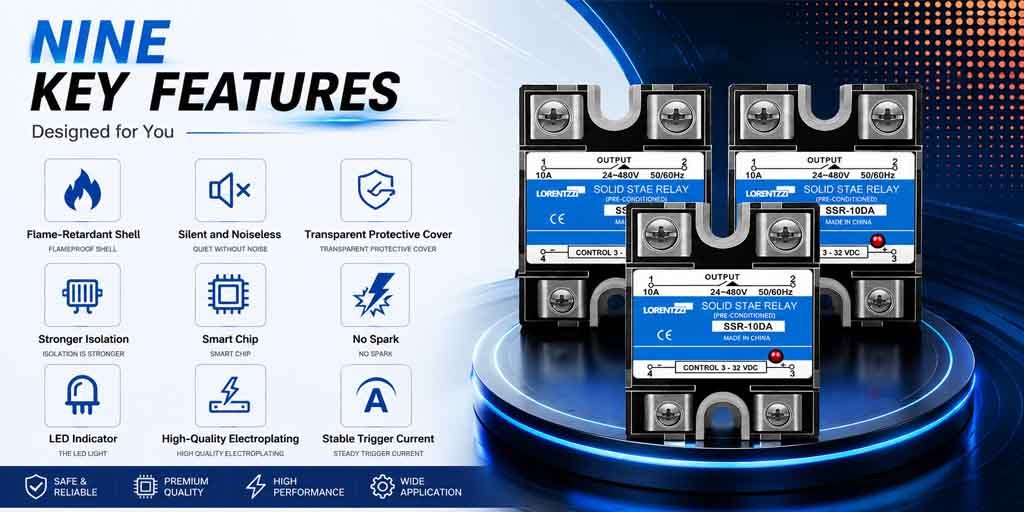
Solid-state contactors have 4 major advantages: arc-free switching, silent operation, zero mechanical wear, and support for high-frequency and rapid switching cycles.
In the following part, we will explain each advantage in more details:
- Arc-free switching: Mechanical switches or electromagnetic contactors use physical contacts to form a closed circuit. Air exists between the two contacts. When the circuit is closed, high voltage can cause the air to break down and ionize, forming a conductive path and generating an electric arc. Solid-state contactors, on the other hand, use semiconductors for switching operations and have no internal air, therefore no electric arc is generated when the circuit is closed.
- Silent operation: If you have used electromechanical contactors or general-purpose relays before, you will know that you hear a lot of noise when connecting a load. This noise is caused by physical contact. Solid-state contactors, on the other hand, have no physical contact, so they can operate silently when connecting or disconnecting a circuit.
- Zero mechanical wear: Electric arcs and prolonged physical contact can cause wear, but as mentioned earlier, solid-state contactors do not have electric arcs or physical contact, so they do not produce mechanical wear.
- High-frequency and rapid switching: If you’ve read our blog post: Transistor vs. Relay Output, you’ll know that semiconductor switches are much faster than mechanical switches, hence the high-frequency fast switching characteristics of solid-state contactors.
Solid-state contactor vs mechanical contactor
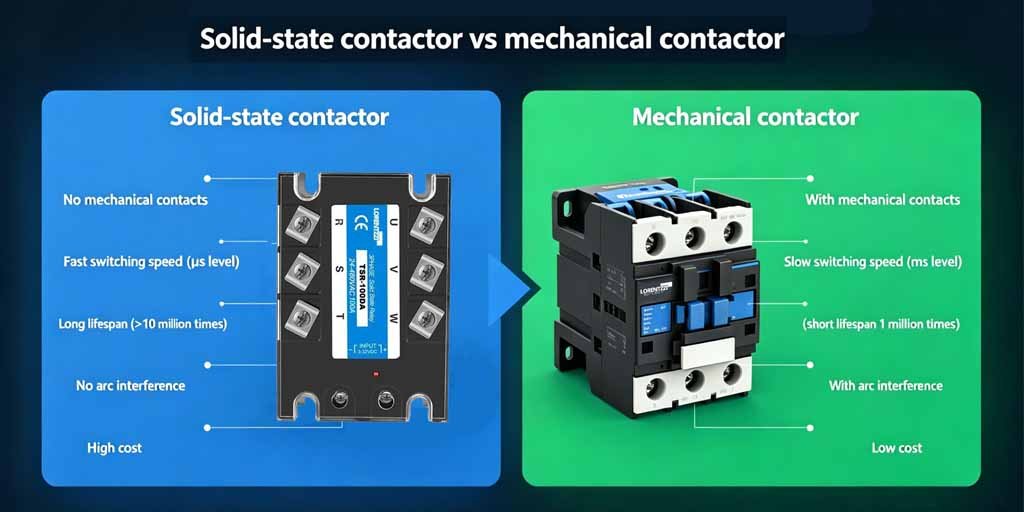
When comparing solid-state contactors with mechanical contactors, there are clear differences between the two.
Solid-state contactors operate spark-free and silently, but they generate relatively more heat during operation.
By contrast, mechanical contactors produce electric arcs and operating noise when switching. However, they can withstand higher current loads. And unlike solid-state contactors, they do not overheat easily even under long-term continuous operation.
We have written a detailed comparison between these two products, you can learn more through: SSR Vs Relay: Which One Is Better?
Main applications of solid-state contactors
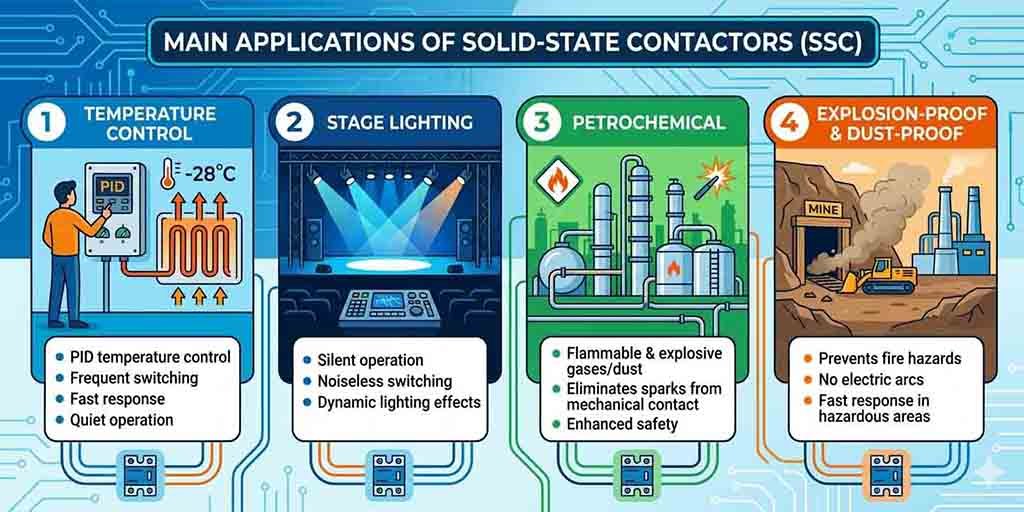
Solid state contactors can be used in various kinds of applications, but there are top 4 typical applications:
- Temperature control field: To maintain a constant temperature, a PID temperature controller should usually be used. The switching frequency is very high, so fast response time and quiet operation are very important. Therefore, it is recommended to use a solid-state contactor (SSC/SSR).
- Stage lighting control: No one wants to hear noise at a concert, so silent operation of stage lighting is crucial. Solid-state contactors are a good choice because they are noiseless when switching on and off.
- Petrochemical field: Petrochemical sites typically contain flammable and explosive gases and dust. Ordinary mechanical contacts can generate sparks when opening and closing, posing a safety hazard. Solid-state contactors, on the other hand, lack arc-extinguishing contacts and are inherently safer.
- Explosion-proof and dust-proof working scenarios: In fields such as mining and alcohol production workshops, fires or small electric arcs should be avoided. Solid-state contactors are the ideal choice due to their advantages of no electric arc and fast response.
Also, you can see our blog post for more information: Solid State Relay Applications: A Comprehensive Guide.
Common types of solid-state contactors
Solid-state contactors are mainly divided into single-phase and three-phase types. Single-phase solid-state contactors are designed to control single-phase loads, while three-phase contactors are suitable for three-phase industrial loads such as motors, heaters, and automated production lines.
Based on the control method, solid-state contactors can also be further divided into DC-controlled AC type(ie. our 40DA SSC), DC-controlled DC type(ie. our 40DD SSC), and AC-controlled AC type(ie. our three phase 60A SSC) to meet different industrial power switching requirements.
You can learn more solid state contactor types by reading this article: Solid State Relay Types: How to Choose the Right SSR for Your Application.
How to choose the right solid-state contactor (buying guide)
When selecting a solid-state contactor, firstly there are 6 key points to consider. You can refer to our article: Solid State Relay Tutorial: 6 Essential Installation Tips For Optimal Performance.
Next, we will guide you step-by-step through selecting the right solid-state contactor, in 7 steps:
- Determine whether your load is single-phase or three-phase: If your load is two-wire and operates at 110VAC or 220VAC, it means your load is single-phase, so you need to use a single-phase contactor to operate your load; if your load is three-wire and operates at 220VAC or 380VAC, you need a three-phase solid-state contactor.
- Determine if the load is DC or AC: The next step is to check whether your load is DC or AC type. DC loads can only be operated by DC solid-state contactors(Please refer to the solid-state contactor load terminals and do not confuse the control terminals with the load terminals.), and AC loads can only be operated by AC solid-state relays. Misusing a solid-state contactor may permanently damage your solid-state contactor.
- Confirm the control signal: The control signal of a solid-state contactor is the same as that of a regular electromechanical contactor coil. The control voltage can be DC or AC. Please confirm which control voltage can be utilized in your application.
- Determine the rating of the solid-state contactor: If the load is a resistive load (such as a heating element), the load current should be twice the load current; if the load is a motor, the solid-state contactor current should be 5-7 times the motor’s rated current.
- Select a suitable fast-acting fuse: The fast-acting fuse should be connected to the input section of the SSC, and the rated current of the fast-acting fuse should be 1.5 times the current of the solid-state contactor. For guidance on selecting fast-acting fuses, you can refer to this blog post: How to Select the Right Fast-Acting Fuses for Your Solid-State Relays?
- Choosing the right heatsink: Since SSCs are semiconductors, they generate a lot of heat when running under load, so good heat dissipation is important. You can choose the right heatsink by looking at our SSR heatsink category: SSR Heatsinks.
- Installation Notes: Unlike ordinary electromechanical AC contactors, solid-state contactors can be divided into panel-mounted and DIN rail-mounted types. Please select the appropriate solid-state contactor and use the correct installation method.
Conclusion
In conclusion, solid-state contactors outperform conventional electromechanical contactors in many key aspects, including spark-free operation, silent performance and fast response time.
However, they have certain limitations in terms of load capacity and heat dissipation compared with traditional electromagnetic contactors.
If you have any further questions or would like to purchase high-quality solid-state contactors from China, you can try sending your inquiry to shonxu@lorentzzi.com or filling out the form on our contact us page!