
In industrial automation and control systems (such as CNC machine tools, packaging lines, woodworking machinery, and conveying systems), proximity sensors and photoelectric sensors are two of the most widely used non-contact object detection solutions.
Both proximity sensors and photoelectric sensors offer reliable, wear-free switching performance, but their operating principles, detection ranges, material compatibility, and environmental tolerances differ significantly.
This guide will detail three key aspects you need to understand to help you make the right choice:
- Definitions of proximity sensors and photoelectric sensors,
- Main differences between the two types of sensors,
- How to choose the right sensor for your application.
What is a proximity sensor?
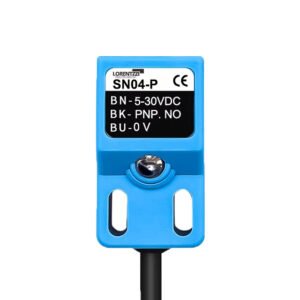


Proximity sensors (sometimes called proximity switches) are typically used with PLCs or other microprocessors such as Arduino and Raspberry Pi to detect the presence of objects in a non-contact manner.
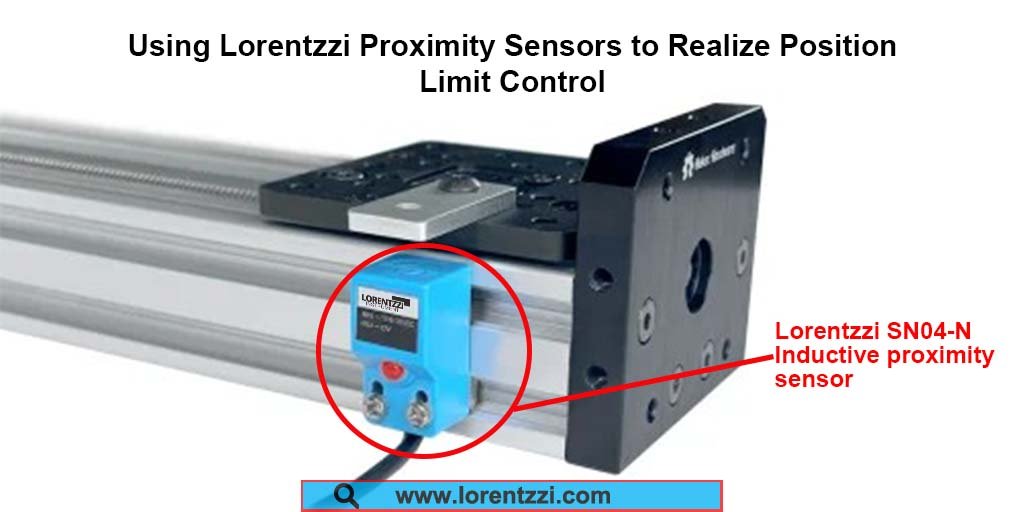
When an object enters the detection range, the sensor sends a low-level (NPN sensor), high-level (PNP sensor), or DC/AC voltage signal (relay output sensor) to the PLC. The PLC then interprets the signal and executes the next operation, such as stopping the movement or controlling the pneumatic cylinder to perform a push-pull motion.
Types of proximity sensors & working principles
There are three main types of proximity sensors: inductive proximity sensors, capacitive proximity sensors, and Hall effect proximity sensors.
The next section will explain the working principle of each type of sensor in detail:
- Inductive proximity sensor: An inductive proximity sensor detects objects by sensing changes in an electromagnetic field. When a metallic object enters the detection range, the eddy currents generated on its surface weaken the electromagnetic field, thus triggering a switch output.
- Capacitive proximity sensor: A capacitive proximity sensor detects objects by sensing changes in capacitance. When a target object enters the detection range, the capacitance between the sensor electrodes and the target object changes, thus triggering a switch output.
- Hall effect proximity sensor: A Hall effect proximity sensor detects objects by sensing magnetic fields. When a target object enters the detection range, the Hall sensor detects the change in the magnetic field and then triggers a switch output.
Core advantages & limitations
The main advantage of inductive and Hall effect proximity sensors is their ability to operate in harsh industrial environments, such as dusty, oily, and humid conditions.
Since dust, moisture, and oil are not metallic and magnet, they do not affect detection accuracy or cause false triggering.
Their limitation lies in their relatively short sensing distance; typically, proximity sensors have a sensing distance of less than 120 mm(Lorentzzi Electric’s 120 mm sensing distance inductive proximity sensor: LMF41 Inductive Non Contact Proximity Sensor).
What is a photoelectric sensor?
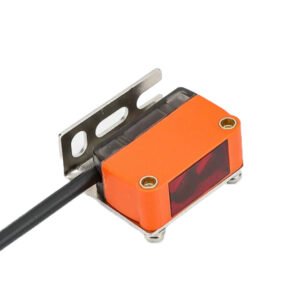
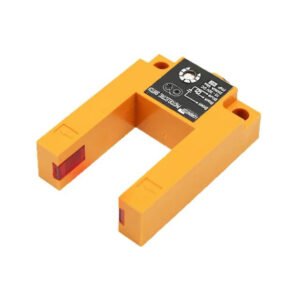

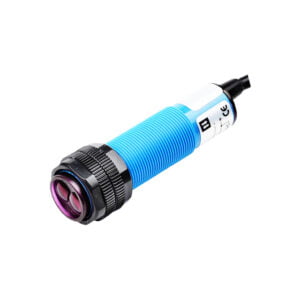
Photoelectric sensors are another type of non-contact object detection device, unlike the inductive, capacitive, and Hall-effect proximity sensors described earlier; they use light to sense objects.
Therefore, they have a faster response time, higher accuracy, and can detect objects at a greater distance.
Types of photoelectric sensors & working principles
There are three types of photoelectric sensors: diffuse photoelectric sensors, retro-reflective photoelectric sensors, and through-beam photoelectric sensors.
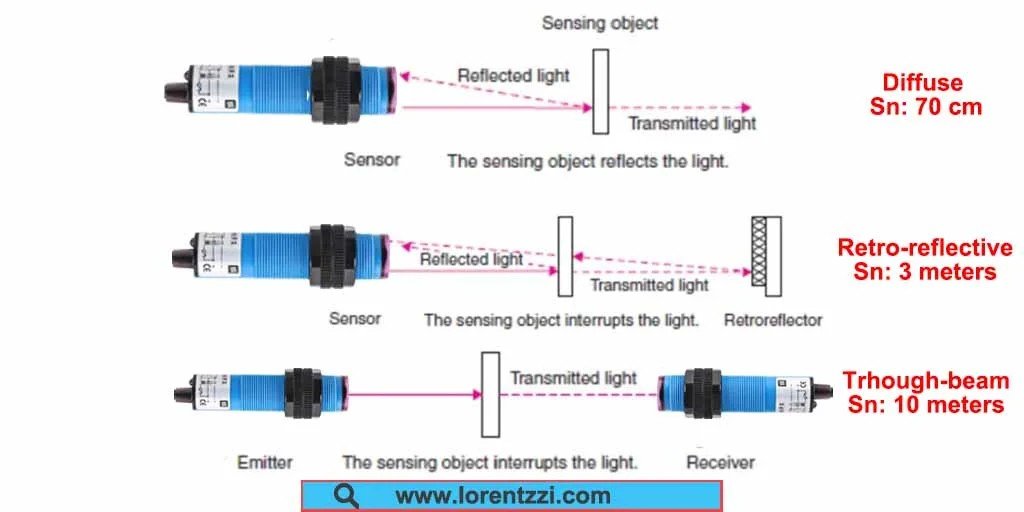
- Diffuse photoelectric sensor: A diffuse photoelectric sensor integrates the transmitter and receiver into a single housing. It emits a beam of light, and triggers an output when it detects light reflected back from a target object.
- Retro-reflective photoelectric sensor: The working principle of a retro-reflective photoelectric sensor is almost the same as that of a diffuse photoelectric sensor, but it uses a mirror as a reflection point to detect objects. When the reflected light is blocked or not blocked, the output will be triggered.
- Through-beam photoelectric sensor: Unlike diffuse and retro-reflective photoelectric sensors that integrate the transmitter and receiver in a single housing, through-beam photoelectric sensors have separate transmitters and receivers. In dark mode, it triggers an output when light between the transmitter and receiver is blocked; in bright mode, it outputs a signal when there is no object between the transmitter and receiver.
Core advantages & limitations
The core advantages of photoelectric sensors lie in their fast response speed, high detection accuracy, and ultra-long sensing distance (up to 10 meters), making them suitable for detecting objects of various materials.
However, their limitation is that to avoid false triggering, the environment must be extremely clean; otherwise, strong light, dust, or oil will block the light, leading to false triggering.
Proximity sensors vs photoelectric sensors: 5 key differences
Compared to photoelectric sensors, proximity sensors have five main differences, such as working principle, detection range, detection materials, environmental requirements, and response time.
| Item | Proximity sensor | Photoelectric sensor |
|---|---|---|
Working principle |
Objects are detected by relying on changes in electromagnetic fields, capacitance, or the presence or absence of magnetic fields. |
The presence of an object is detected by detecting whether there is reflected light returning or emitted light. |
Detection range |
1 mm to maximum 120 mm |
50 mm to maximum 10 meters |
Detected materials |
Any metallic object (inductive proximity sensor), magnetic object (Hall effect sensor), any material object (capacitive proximity sensor) |
Any material object, such as metal, plastic, glass, liquid, transparent objects |
Environmental requirements |
It is not demanding in terms of environment; even the presence of dust, oil, or other contaminants will not affect the accuracy of the test. |
The environment must be very clean and tidy, the lighting intensity should not be too strong, direct sunlight should be avoided, and the illuminance should be below 10,000 lux. |
Response time |
Typically < 1 ms |
Typically < 0.1 ms |
Typical applications: when to use which?
Best scenarios for proximity sensors
- Limit and origin detection of machine tools and other automated equipment;
- Counting of metal workpieces and workstation position detection on production lines; cylinder position feedback;
- Gear speed and rotational speed detection;
- Detection of machining stations in workshops contaminated with heavy oil and dust.
Best scenarios for photoelectric sensors
- Packaging line: Inspection and counting of cartons, plastic bottles, and packaging bags;
- Logistics and warehousing: Goods arrival, correction, sorting, and inspection; Transparent glass bottles, films, and liquid level detection;
- Long-distance access control, security protection, and channel detection.
- For more detailed applications of photoelectric sensors, you can read this article: Photoelectric Sensor Applications: 5 Typical Examples.
Conclusion
In summary, proximity sensors are suitable for short-range industrial inspection and positioning and limiting applications in harsh environments.
Photoelectric sensors, on the other hand, offer longer detection distances and a wider range of material detection capabilities, making them the standard choice for packaging, food, and logistics counting applications.

Lorentzzi Electric, a Chinese professional manufacturer and supplier of proximity and photoelectric sensors, offers high-quality products at affordable prices. If you are looking for a reliable business partner, please contact us for more information!