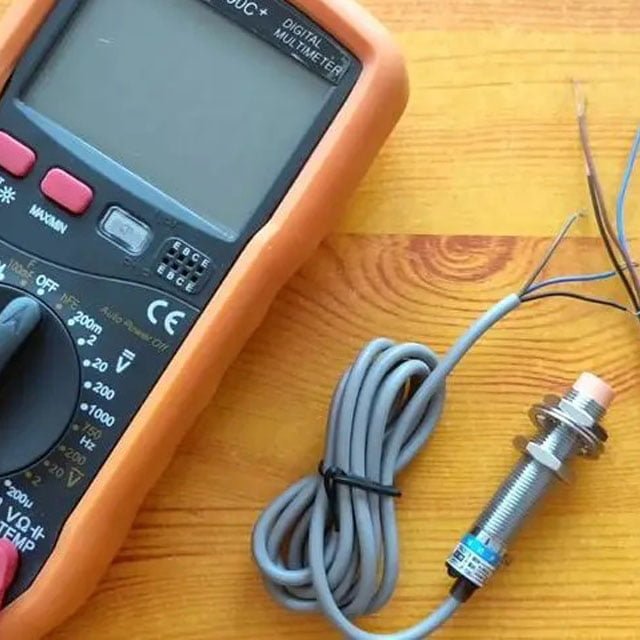

Solid-state relays are key components in temperature control systems (such as HVAC systems, electric water heating systems, saunas, injection molding machines, etc.) used to promptly and accurately turn heating elements on and off, achieving precise temperature control.
All solid-state relays primarily employ two control methods: zero-crossing control and random turn-on control.
What are zero-cross solid-state relays and random turn-on solid-state relays? What are their advantages, disadvantages, and main differences? How to choose the best product?
To answer these questions, we will provide a detailed explanation in this article.
What is a zero-cross solid-state relay?
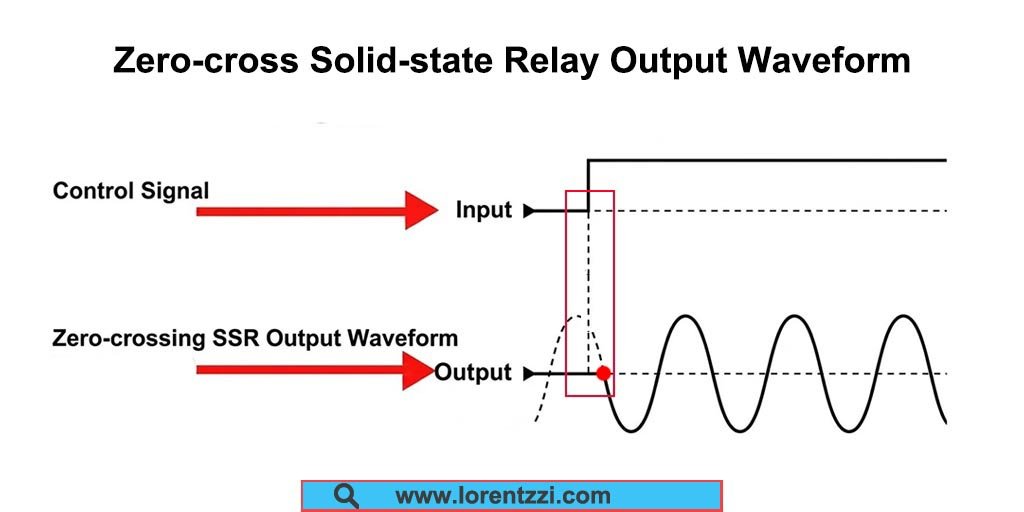
A zero-cross SSR does not turn on immediately after receiving a control signal; they wait for the AC electricity to cross zero before connecting the load. These SSRs have a built-in zero-crossing voltage detection circuit (as shown in red in the diagram below).
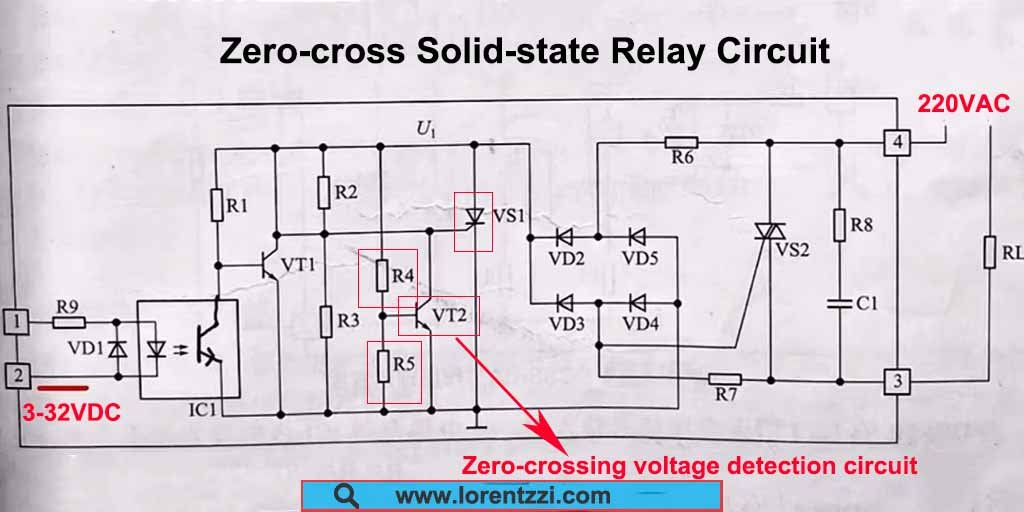
The working process of the zero-cross solid-state relay is as follows: When a control input signal is received, the output of the solid-state relay does not immediately turn on, but waits for the AC sinusoidal voltage to drop to the zero-crossing point before activating the output circuit. When the input signal is removed, the solid-state relay will automatically turn off at the next zero-crossing point.
Advantages of zero-cross SSRs
- Lower electrical noise: Because zero-cross solid-state relays (SSRs) turn on near zero voltage, sudden changes in load voltage are reduced. This helps to minimize electromagnetic interference (EMI).
- Reduced inrush current for many resistive loads: Connecting a resistive load near the voltage zero-crossing point reduces the initial inrush current compared to switching it on at the high point of the AC waveform. This avoids the impact of surge voltage and current on heater lifespan.


Disadvantages of zero-cross SSRs
The main drawback is that solid-state relays (SSRs) cannot turn on at any point on an AC waveform.
After receiving a control signal, it may need to wait for the next suitable zero-crossing.
For typical heating applications, this delay is usually negligible. However, for some loads that require immediate power connection, this delay can be a significant disadvantage.
What is a random turn-on solid-state relay?
Unlike zero-crossing solid-state relays, random turn-on solid-state relays (also known as instantaneous-on solid-state relays) do not require the AC voltage to reach a zero-crossing point to turn on.
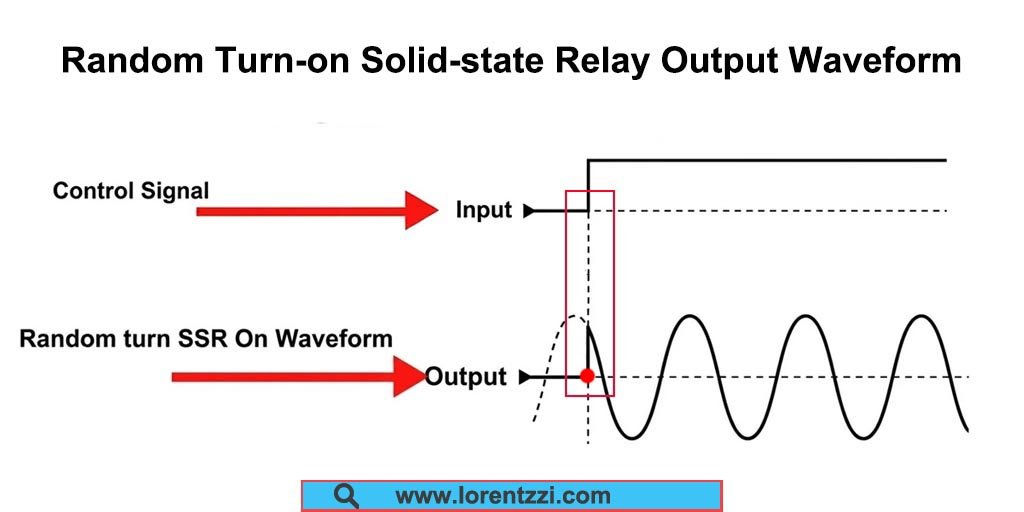
When a control voltage is applied to the control terminal, the load terminal immediately conducts. In other words, after applying a control signal, the load terminal can conduct at almost any point on the AC waveform.
For example, if a control signal is applied when the AC voltage is close to its peak voltage, the random turn-on solid-state relay will turn on at that point without waiting for the next zero-crossing point.
Advantages of random turn-on SSRs
- Faster response: The random turn-on SSRs do not need to wait for the next zero-crossing point; they can start conducting immediately after the control signal is applied.
Disadvantages of random turn-on SSRs
- Electrical noise and electromagnetic interference: Switching at any point on the AC waveform can generate greater electrical noise and electromagnetic interference.
- High inrush current: It also generates high transient current, which can affect the lifespan of certain loads that are sensitive to surge current, such as incandescent/halogen lamps, precision sensors, and instruments.
Zero-Cross SSR vs Random Turn-On SSR: Full Comparison Table
Zero-crossing solid-state relays (SSRs) and random turn-on solid-state relays(SSRs) differ in many ways, primarily in their turn-on point, turn-on delay, zero-crossing detection circuit, electrical noise, and electromagnetic interference and so on.
The table below details these differences for your reference.
| Feature | Zero-cross SSR | Random turn-on SSR |
|---|---|---|
Turn-on point |
Near AC voltage zero crossing |
Any point on the AC waveform |
Turn-on delay |
Need to wait for the next zero crossing |
Nearly no switching delay |
Zero-cross detection circuit |
Yes |
No |
Electrical noise |
Low |
High |
EMI |
Low |
High |
Inrush current |
Low |
High, but depending on switching point and load |
Temperature control |
Excellent |
Excellent |
Resistive heaters |
Suitable |
Suitable |
Loads sensitive to surge current |
Suitable |
Not suitable |
Typical applications |
Heaters, ovens, HVAC, water heaters |
Heaters, ovens, HVAC, water heaters, lighting |
How to choose between the zero-cross SSR and random turn-on SSR?
Both zero-cross and random turn-on solid-state relays can be used for precise control of heaters and other loads.
If your circuit requires reduced electrical noise and electromagnetic interference (EMI) to other components, use a zero-cross solid-state relay.
If you need rapid control of heaters or other loads, we strongly recommend using a random turn-on solid-state relay.
In the market, most solid-state relays are manufactured in a zero-cross control mode unless special requirements are made to the solid-state relay manufacturers and suppliers.
Conclusion
In short, whether you choose to use a zero-cross solid-state relay or a random turn-on solid-state relay to control the heater, they can precisely control the heater temperature.
The main difference lies in whether they generate electrical noise and surge current to the load.
Lorentzzi Electric, a professional solid-state relay supplier in China, offers high-quality, zero-crossing and random turn-on solid-state relays at highly competitive prices. Please contact us for more information about our solid-state relays!