
Recently, a user from Miami, USA, who has contacted us already on WhatsApp, was confused about the difference between a solid-state voltage regulator(SSVR) and an automatic voltage regulator(AVR).
His customers in Latin America had very unstable voltage, fluctuating between 90-130 VAC. This was very bad because voltage fluctuations could cause serious damage to refrigerator compressors or other devices with motors (low voltage causes too much current, causing the compressor coils to get very hot and eventually burn out).
Therefore, he wants to use a solid-state voltage regulator to solve this problem and achieve stable voltage control.
I advised him against this. Why? Because SSVR regulator and AVR are two completely different products with completely different operating principles.
So, what exactly is the difference between a solid-state voltage regulator and an automatic voltage stabilizer? How do they work? In this article, we will explain in detail.
What is a solid state voltage regulator?
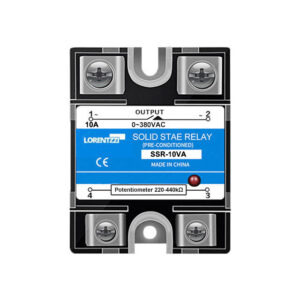


A solid-state voltage regulator (commonly known as an SSVR) regulates the output voltage to a load. Typically, the control signal is an analog signal, such as 4-20 mA, 0-5 VDC, or 0-10 VDC.
To better understand how this works, let’s use an example:
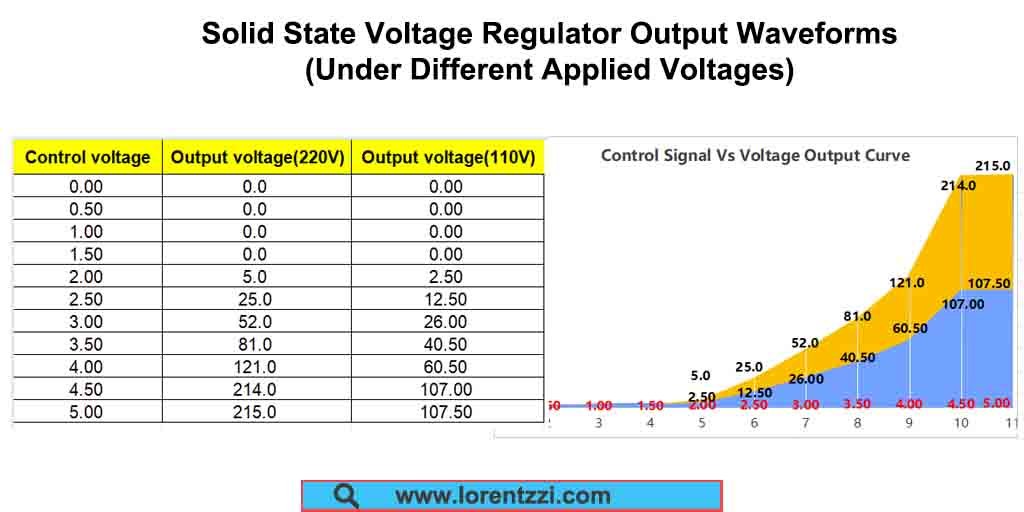
I now connect an external 220 VAC voltage to the controlled terminals of a solid-state voltage regulator, which is then connected in series with a heating element to form a closed circuit.
As the analog control signal increases, the output voltage rises correspondingly, with a linear input-output curve.
For example, if the voltage across the load (heating element) is currently 121.0 VAC (with an external voltage of 220 VAC), but the external voltage is now adjusted to 110.0 VAC (while the control signal remains unchanged at 4 VDC), what will happen?
What is a voltage stabilizer(AVR)?
A voltage stabilizer(AVR) is an electronic device that automatically maintains a stable output voltage regardless of fluctuations in the input voltage or connected load.
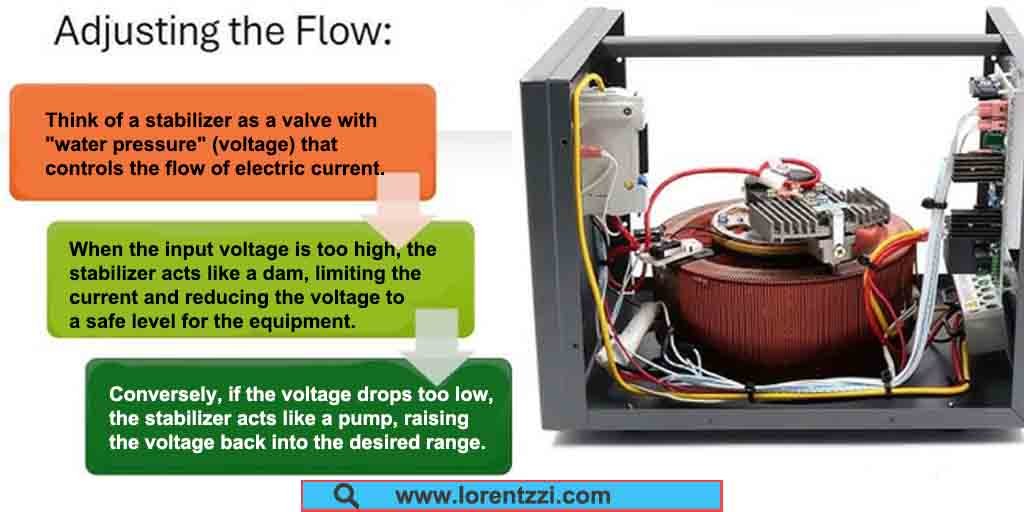
You can think of it as a “voltage protector” or “voltage smoother.” It ensures that sensitive electronic devices connected to it receive a constant, stable, and accurate voltage, protecting them from damage and ensuring their proper operation.
You can simply think of it this way: I want a stable voltage of 220 VAC. When the external power supply voltage is below 180 VAC or above 220 VAC, the output voltage remains at 220 VAC.
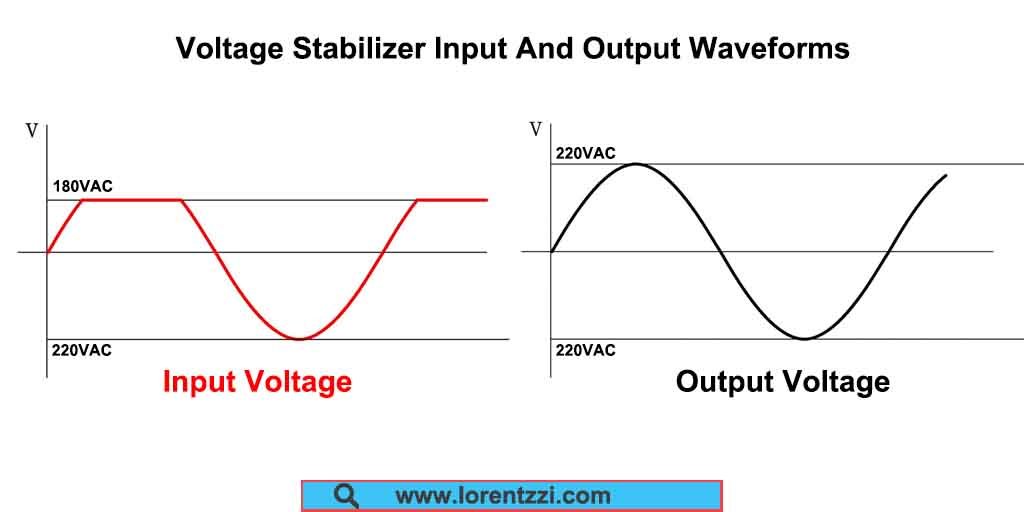
You can watch the video below to see how it works:
What are the key differences between SSVR and AVR?
The differences between solid-state voltage regulators and voltage stabilizers primarily lie in 5 areas: operating principle, functionality, product weight and size, application scenarios, and cost.
We’ll explain each of these below.
1. Working principle
Solid-state voltage regulators typically adjust the output voltage by changing the phase angle of a thyristor within the circuit.
For example, an external 4-20mA signal or a potentiometer can be used to adjust the conduction angle of the thyristor, thereby varying the output voltage.
Unlike solid-state voltage regulators, voltage stabilizers use the closed-loop negative feedback principle to control the output voltage.
It consists of a voltage regulator circuit, a control circuit, and a servo motor. When the input voltage or load changes, the control circuit samples, compares, and amplifies the data.
It then drives the servo motor to rotate, changing the position of the voltage regulator’s carbon brushes. This automatically adjusts the coil turns ratio to maintain a stable output voltage.
This process is continuous, allowing for real-time regulation of the output voltage.
2. Functions
Solid-state voltage regulators provide linear output voltage control, allowing the output voltage to vary between 0% and 100% of the input voltage.
On the other hand, voltage regulators stabilize the voltage at a fixed level or range, ensuring that the output voltage remains stable even if the input voltage fluctuates.
3.Weight and dimensions
Generally speaking, under the condition of the same output power, the automatic voltage regulator (AVR) is heavier and larger than the solid-state voltage regulator.
This is because the voltage regulator uses a transformer to stabilize the output voltage, and the transformer is composed of an iron core and a copper coil. The iron core and the copper coil have high density and are heavier.
4.Application scenarios
Solid-state voltage stabilizers are widely used in applications requiring voltage regulation, such as controlling the output power of heating elements in heating systems and the speed of torque motors, fan speed control.
Voltage stabilizers are widely used in applications requiring a stable power supply, such as industrial and mining enterprises, oil fields, railways, construction sites, schools, and hospitals.
5.Cost
Because voltage stabilizer control mechanisms are more complex and require more materials to produce, voltage regulators are generally more expensive than solid-state regulators.
How to choose between them?
Now let’s look at how to choose between these two products.
In short, if you want a linear output voltage from 0-100%, use a solid-state voltage regulator. If you want a stable voltage, choose a voltage stabilizer.
Conclusion
In summary, solid-state voltage regulators and voltage stabilizers are both used to control voltage, but the above comparison clearly demonstrates that they are completely different products.
If you still have questions or would like to inquire about the price of our high-quality Lorentzzi brand solid-state voltage stabilizers, please email shonxu@lorentzzi.com.
Lorentzzi Electric has been supplying solid-state voltage regulators worldwide for many years and enjoys an excellent reputation. We sincerely welcome your inquiries or project discussions.