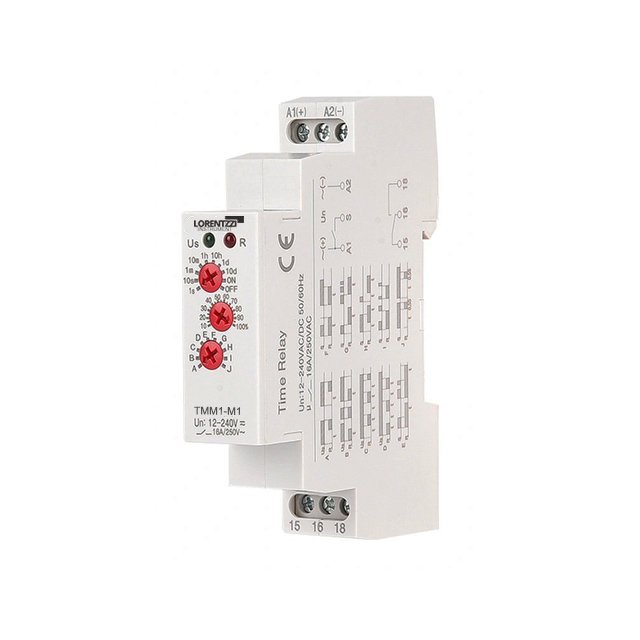
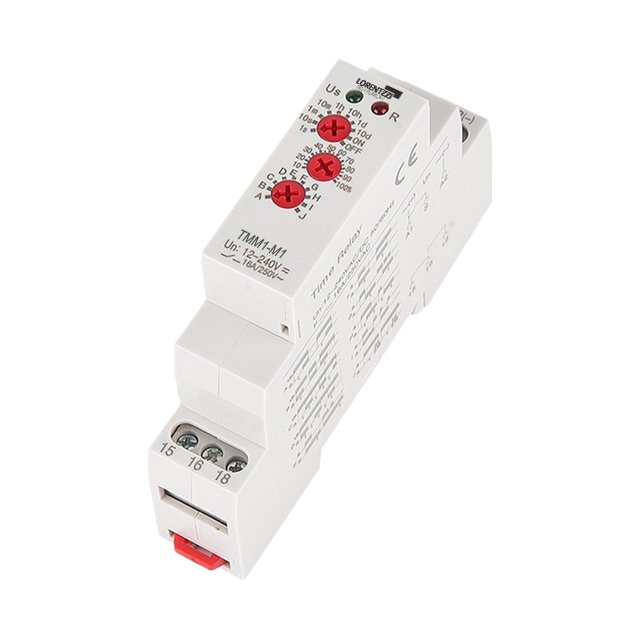
What Is A Multi-function Time Delay Relay?
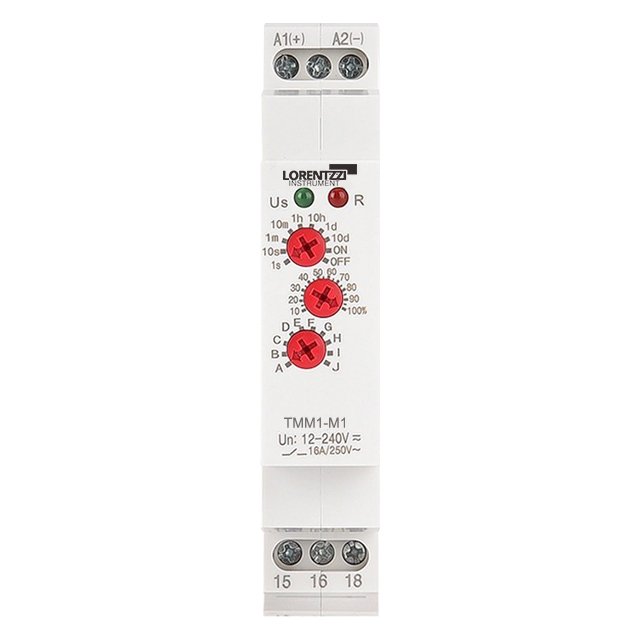
Lorentzzi® TMM1 multi-function time relay integrates different time control functions into one product, and can be used as a on delay relay, off delay time relay, a repeating cycle time-delay relay, etc.
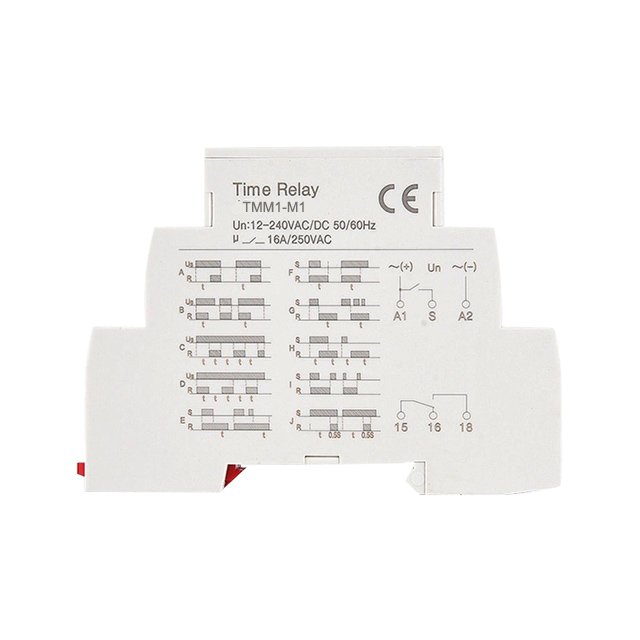
Specifically, it has up to 10 working modes, namely:
- Mode A: On-delay relay,
- Mode B: Power-on interval ,
- Mode C: Cycle delay OFF start,
- Mode D: Cycle delay ON start,
- Mode J: Pulse output.
These 5 working modes are based on external power supply, these functions are the same as our H3CR-A8 time delay relay.
The remaining 5 working modes work according to the external signal (S), which are:
- Mode E: S signal on, the delay starts when it is turned off,
- Mode F: Delay immediately after control signal S is connected,
- Mode G: Control signal off-delay,
- Mode H: Control signal on-delay and off-delay,
- Mode I: Self-locking.
We will introduce these 10 working modes in detail in the following section.
Description of Each Mode:
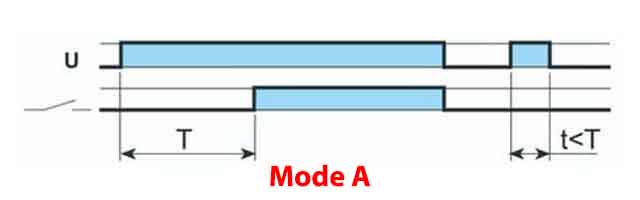
Mode A: When the product is powered on, it starts to delay according to the set time (T). When the delay time is up, the normally open contact closes immediately. When the power is disconnected, the normally open contact resets.
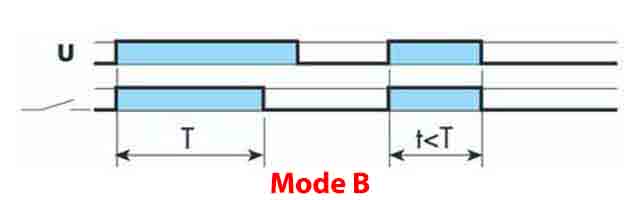
Mode B: After the product is powered on, the normally open contact closes immediately, and the product starts working after a set time (T). After the set time T ends, the normally open contact opens. If the delay does not end and the product is powered off, the normally open contact opens immediately.
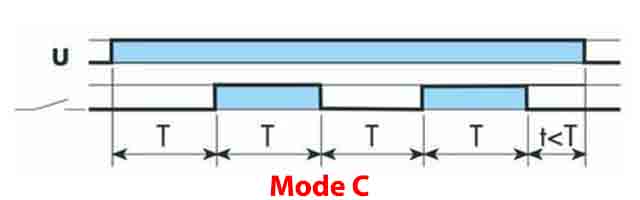
Mode C: Repeats in a loop, with delayed power-on starting first.
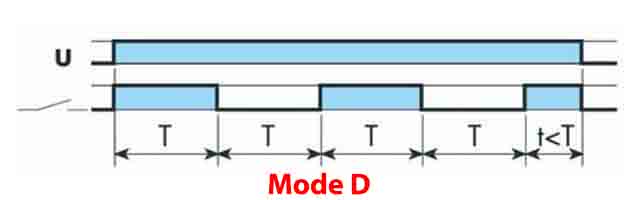
Mode D: Repeats in a loop, with power-on starting first.
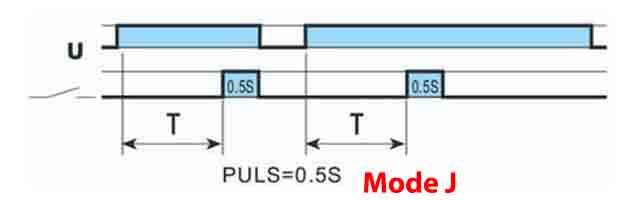
Mode J: After the product is powered on, it will immediately begin a delay for the set time (T). After the delay ends, the normally open contact will immediately close, generating a pulse that lasts for 0.5 seconds.
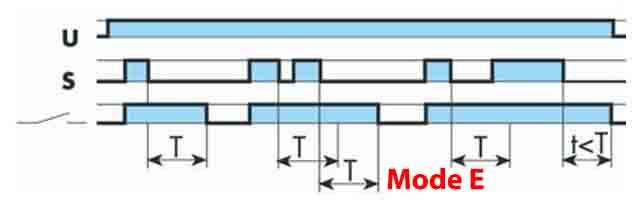
Mode E: After the product is powered on and connected to the signal (S), the load is immediately work, and the connection is disconnected after a certain period of time following the falling edge of the control signal.
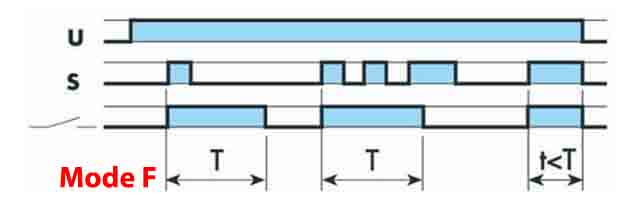
Mode F: The product starts working immediately after being powered on and connected to the signal (S), and disconnects after a delay of T on the rising edge of the control signal.
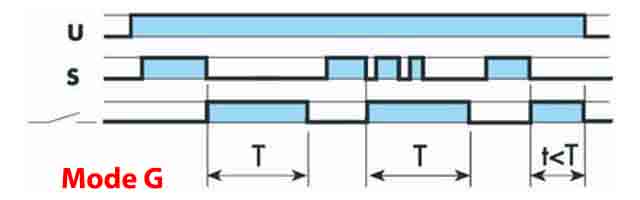
Mode G: When the product is powered on and the signal (S) is on, the load will start working on the falling edge of the control signal and continue until time T.
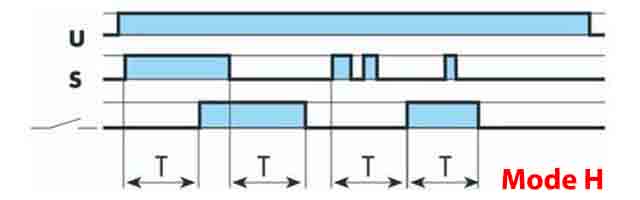
Mode H: After the product is powered on and the signal (S) is connected, the load will start after a delay of T and continue to work for T, and the cycle will repeat.
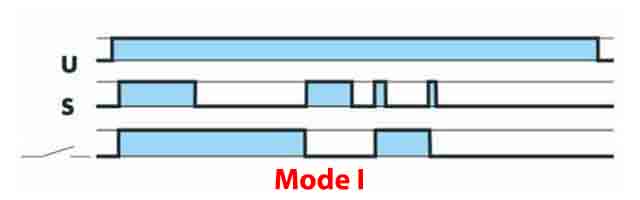
Mode I: Self-locking function. When the product is powered on and the signal (S) is turned on, the normally open contact closes immediately; when the signal (S) is turned on again, the normally open contact opens.
Applications:
- Motor start-up sequence control,
- Stage lighting and sound sequence control,
- Staircase lighting control,
- HVAC heating and cooling control,
- And so on.
Specifications:
| Model | TMM1 |
| Working voltage | DC12V, DC24V, AC110V, AC220V, AC380V, AC/DC24V-240V |
| Function | 10 delay modes, please have a look at the above their desriptions |
| Rated power consumption | AC:≤1.5VA DC:≤1W |
| Delay range | 0.1 s~10 days |
| Setting accuracy | ≤5% |
| Repeat accuracy | ≤0.2% |
| Repeat power-on interval | ≤200ms |
| Electrical Life | 10^5 |
| Mechanical life | 10^6 |
| Altitude | ≤2000m |
| Contact configuration capacity(A) | 1NC/NO:8A; 2NC/NO, 2NC/NO, 1NC/NO+1instant NC/NO:5A |
| IP Class | IP20 |
| Class of pollution | Ⅲ |
| Use category | AC-15 |
| Contact capacity | Ue/leAC240V/1.5A,AC380V/0.95A |
| Output type | 1NC/NO;2NC/NO;1NC/NO+1 instant NC/NO |
| DIN rail Standard | (width)35mm(IEC/EN60715) |