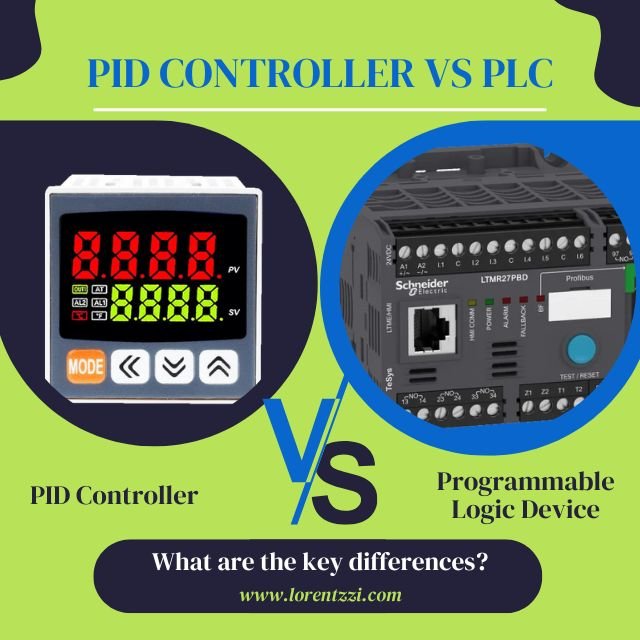
When choosing the key control component (or “control brain”) for your industrial control system, for example, constant temperature control, you have two options: PID controllers and PLCs.
So, what are these two products? What’s the difference between them? And which one should you use?
In this article, we’ll provide you with deeper insights than any other you’ve read before.
Now let’s get started!
What is a PID controller?
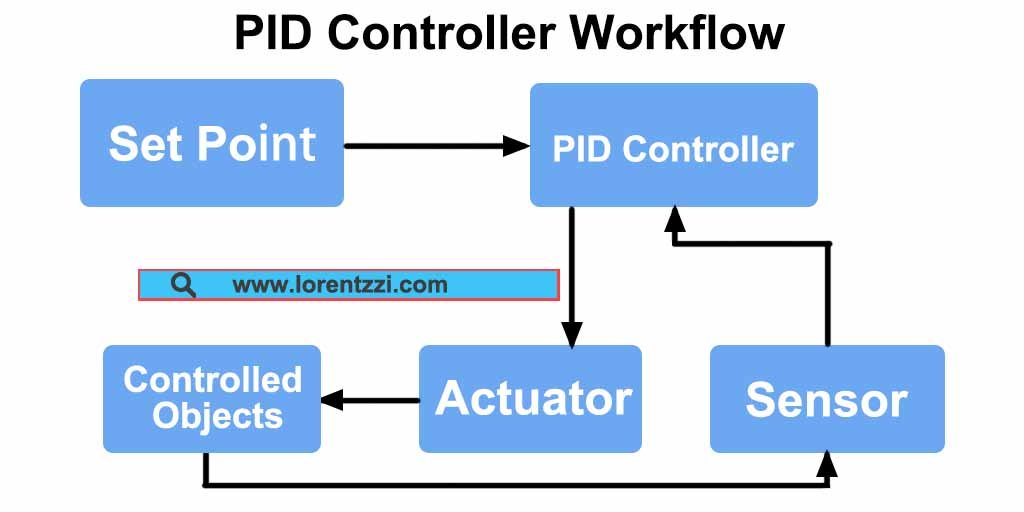
A PID controller is designed to maintain a setpoint (desired value) in a system by adjusting its output based on three parameters: proportional, integral, and derivative.
A PID control loop consists of three main components: the controlled object (e.g., a heating element), a sensor that provides real-time feedback, and the PID controller itself. The controller continuously compares the measured value with the set-point and adjusts the output accordingly to minimize the error.
By tuning these three parameters appropriately, stable and accurate control of the system can be achieved.
PID controllers are widely used in applications involving temperature, flow, and pressure control.
What is a PLC?
Now let’s learn about PLCs.
PLC stands for Programmable Logic Controller (PLC). It’s commonly used to handle complex tasks not only PID control but also sequential control, distance control, proximity control, and counting control and so on.
PLC inputs and outputs can be a variety of types: discrete (on/off), analog (continuous voltage or current), temperature sensors, encoders, and even serial or Ethernet data packets.
This flexibility allows a single PLC to replace hundreds of hardwired relays, timers, and counters while still fitting into a compact DIN rail-mountable enclosure.
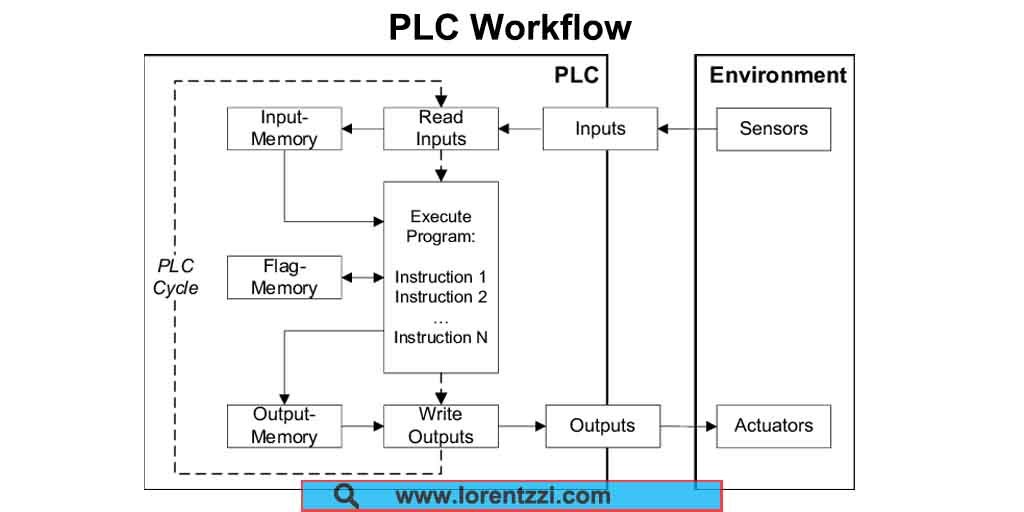
The PLC’s operating process can be divided into three steps: scanning inputs, executing programs, and updating outputs.
Thus, from its operating process, it can be seen that the PLC also operates using closed-loop control logic.
What are the differences between a PID controller and a PLC?
The main differences between PID controller and PLC lie in 8 aspects: purpose, signal processing, control method, speed, application, cost, programmability and using convenience.
In the following chart, we will compare these 8 aspects in details:
| Item | PID controller | PLC |
|---|---|---|
|
Purpose |
Used to handle simple single tasks, such as constant temperature control, constant pressure control, constant flow control, etc. |
Used to handle not only simple single tasks but also complex sequence or process control tasks, for example: bottled water filling control, its process is: empty bottle → filling → capping → labeling → boxing. |
|
Signal processing |
A PID controller accepts only continuous analogue signals – typically thermocouples, RTDs, 4-20 mA or 0-10 V from temperature, pressure or flow transmitters. |
A PLC, by contrast, handles both these analogue signals and discrete (on/off) inputs such as push-buttons, proximity sensors and limit switches; with the appropriate module it can also read high-speed pulse trains from incremental rotary encoders. |
|
Control method |
Time-based continuous feedback (percent output is recalculated every scan to minimize error) |
Event-based/state machine for example: If sensor A is valid and sensor B is invalid, then start the motor. |
|
Speed |
100 milliseconds to 500 milliseconds. |
Milliseconds to hundreds of milliseconds, optimized for heavy I/O. |
|
Application |
Constant temperature oven/tunnel oven, Water pump constant pressure water supply, stand-alone extruder. |
Filling/packaging lines, Robot/conveyor line, Multi-zone boiler group control. |
|
Cost |
PID controllers are inexpensive, typically costing less than $100. |
PLCs typically cost less than $1000 due to their programmable flexibility, versatility, and ability to handle complex tasks. |
|
Programmability |
PID controllers offer only parameter-level programming-setpoints, PID gains, output limits, alarm thresholds, and so on. Programmable PID controllers, such as ramp and soak PID temperature controllers, allow users to store multi-step setpoint profiles, but the control strategy remains a single closed-loop algorithm; an optional autotune function calculates the optimal PID values for that closed-loop. |
The PLC fully supports user programming: ladder logic, function blocks, or structured text define complete machine sequences, enabling it to scan hundreds of I/O points and execute multiple subroutines in a single scan. |
|
Ease of use |
Yes, very convenient to use, no programming knowledge is required to get started. |
Programming knowledge is required, making it relatively difficult for beginners to get started. |
Which one should you use?
The above comparison of PID controllers and PLCs clearly demonstrates their key differences, but which should I ultimately choose?
In short:
If you need sequential control, interlocking control, or multi-point I/O control, you should choose a PLC because of its programmable flexibility.
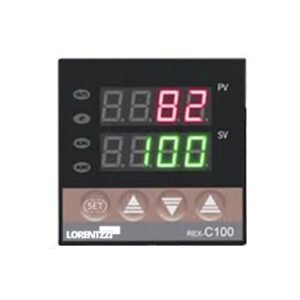
If you need single-loop control, continuous control, or constant value control, a PID controller is the best choice. PID controllers are inexpensive, relatively stable, and require no programming experience.
Conclusion
In conclusion, PID controllers are best suited for simple control scenarios due to their ease of use. PLCs, on the other hand, are more powerful and can perform not only simple PID control but also sequential control and other applications.
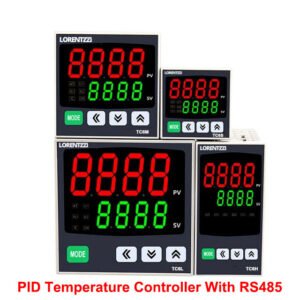
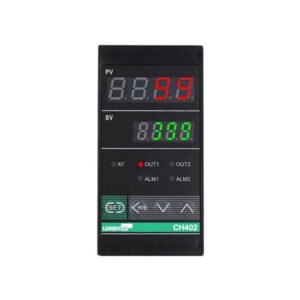
If you’re looking for an easy-to-use PID controller from China, Lorentzzi® offers high-quality, competitively priced options.
Lorentzzi® specializes in providing high-quality PID controllers, solid-state relays, AC contactors, proximity sensors, and incremental rotary encoders.
Contact us today to customize your industrial control solution or get the latest pricing!