
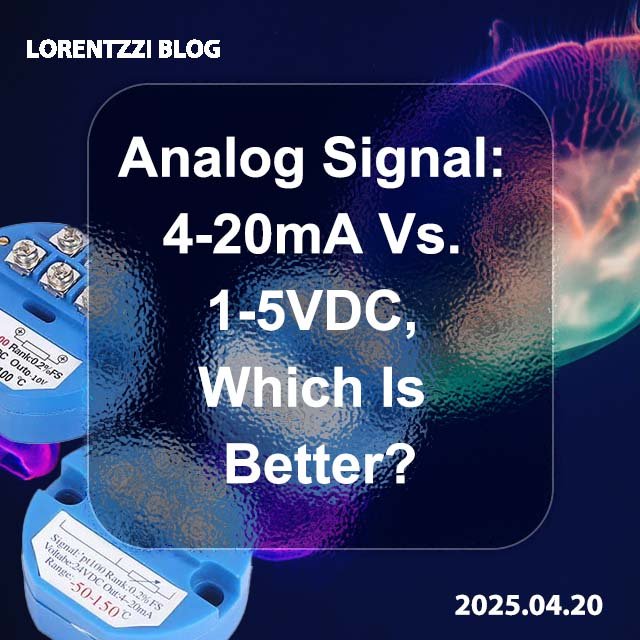
Imagine this: you are a manager in a production workshop and want to know the size of the liquid flow in real time, what should you do? In fact, you can consider converting the flow size into an easily measurable 4-20mA analog electrical signal. By detecting the size of the electrical signal and converting it into the corresponding flow value, you can easily monitor the water flow in real time.
Not only in the above example, but also in the field of automation control, analog signals play a vital role. It is like a ruler. By measuring its value and converting it into corresponding other physical quantities, we can clearly understand temperature, sound, liquid level, etc.
Since it is so important, what exactly is it? How many kinds of analog signals are there in the world? What are their advantages and disadvantages? In this article, we will provide you with comprehensive insights based on the knowledge of the Lorentzzi engineering team.
What is an analog signal?

Unlike digital quantities which are discrete numerical values, analog signals are physical quantities that change continuously in both time and value.
What devices can generate analog signals?
In our Lorentzzi® product range, the following products can generate analog signals: our analog output capacitive proximity sensors, our PID temperature controllers, and our analog output inductive proximity sensors.



In addition, in the industrial field, the following products can also generate analog signals, including temperature sensors, pressure sensors, flow sensors, level sensors, position sensors, vibration sensors, light sensors, etc.
Analog signal types
Standard analog signals can be divided into 0-10VDC, 1-5VDC voltage signals and 4-20mA current signals. Among them, 4-20mA current signals are most widely used in the field of industrial automation.
In the following section, we will explain their advantages and disadvantages respectively.
Advantages and disadvantages of 4-20 mA analog signals

Advantages
- Suitable for long-distance transmission: Since the current signal is not affected by the voltage drop of the transmission line, the 4-20 mA analog signal can be transmitted for up to several kilometers.
- The 4-20 mA current signal can be used to monitor whether the signal generator or transmission line is damaged. For example, when using a 4-20 mA generator, a temperature transmitter, to measure the temperature of 0-100℃, set 0℃ to 4 mA and 100℃ to 20 mA. If the line is disconnected or the temperature transmitter is damaged, the current will drop to 0 mA.
- Suitable for inflammable and explosive occasions without causing electric shock to operators: For example, the analog current signal is transmitted at 24 VDC, and no sparks will be generated when the signal generator is turned off at the application site. According to TUV Rheinland data, it is safe to use 20 mA at 24 VDC.
- Current values can be easily converted to voltage values: Want to convert a 4-20 mA current signal to a 1-5 VDC voltage signal? You just need to add a 250 ohm resistor between the two 4-20 mA wires, so if the current is 4 mA, the voltage is 1 VDC (0.004*250), and the same if the voltage is 5 VDC.
Disadvantages
- Not suitable for sending a signal to multiple receivers: If there are many devices that need to acquire this signal, the receivers need to be connected in parallel, which may exceed the driving capabilities of the signal generator.
Advantages and disadvantages of analog voltage signals

Advantages
- The analog voltage signals can be received by various receivers without increasing the power of the signal generator.
- Analog voltage signals consume less power: Under the same conditions, as the transmission distance increases, the power consumption of voltage signals will gradually decrease.(P=U2/R and P=I2*R)
Disadvantages
- Not suitable for long-distance transmission: As mentioned earlier, the voltage drop in the wire will cause an error between the voltage at the receiving end and the voltage at the sending end, resulting in misjudgment.
Conclusion
In summary, by learning the above knowledge about current and voltage analog signals and understanding their advantages and disadvantages, the Lorentzzi engineering team strongly recommends using 4-20mA analog signals instead of 1-5VDC voltage analog signals.
If you will need our technical support or our analog generator devices such as our analog output capacitive proximity sensor or PID temperature controller, please contact us or send a message to shonxu@lorentzzi.com.