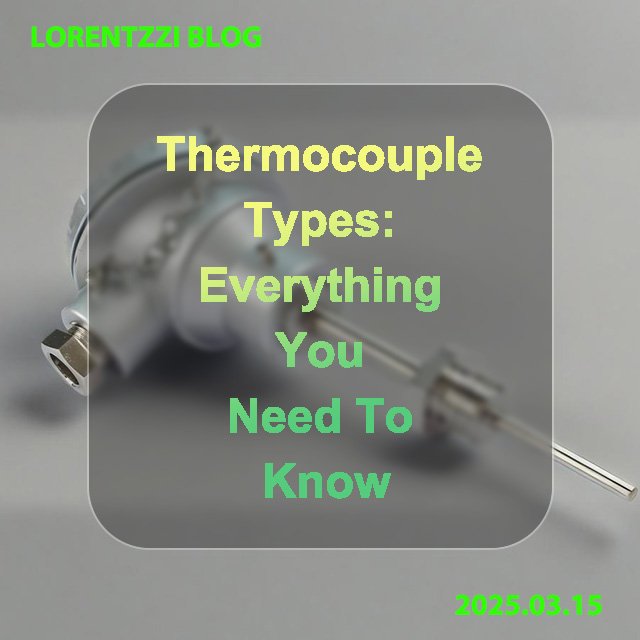
When choosing a thermocouple, you may find that there are too many types of thermocouples available on the market. Are you still struggling about which type is best for your application? This article will list all thermocouples and their advantages and disadvantages. Now, let’s get started!


The working principle of thermocouples is based on the thermoelectric effect (Seebeck effect). When two conductors of different materials of a thermocouple form a closed loop and the hot end and cold end are at different temperatures, a small electromotive force( simply called Emf ) will be generated in the loop.
There is a certain relationship between this thermoelectric force and the temperature difference. By measuring the thermoelectric force and combining it with the temperature-voltage curves above, the temperature of the object being measured can be calculated.
Generally speaking, thermocouples can be divided into K type, J type, E type, T type, N type, B type, S type, R type, C type and M type. We will explain them one by one in the subsequent chapters.
K-type thermocouple

K-type thermocouple is the most widely used of the 10 types of thermocouples.
Material: nickel-chromium alloy (positive electrode) – nickel-silicon or nickel-aluminum alloy (negative electrode)
Temperature measurement range: -200℃ to +1300℃
Features: high accuracy, good stability, low price, and the most widely used.
Application scenarios: industrial furnaces, drying ovens, food processing, chemical reactors, etc.
J-type thermocouple
J-type thermocouple is also a widely used temperature sensor, but its temperature measurement range is narrower than that of K-type thermocouple, so it is more suitable for environments where the temperature is not too high.
Material: Iron (positive electrode) – copper nickel alloy(negative electrode)
Temperature measurement range: -40℃ to +750℃
Features: low cost, high sensitivity, but because iron is the positive electrode, the antioxidant performance is poor.
Application scenarios: low temperature measurement, furnace temperature control, welding temperature measurement, etc.
E-type thermocouple
As shown in the figure above, the voltage/temperature slope of the E-type thermocouple is the largest. That is to say, at the same temperature, the E-type thermocouple can output the highest voltage compared to the K-type and J-type thermocouples, and its change with temperature is also the largest. Therefore, the temperature measurement accuracy of the E-type thermocouple is the highest.
Material: nickel-chromium (positive electrode) – copper-nickel (negative electrode)
Temperature range: -200℃ to +900℃
Features: High sensitivity, suitable for 5 high-precision measurements.
Application scenarios: Measurements in the low to medium temperature range, such as refrigeration equipment and laboratory equipment.
T-type thermocouple

As shown in the figure above, T-type thermocouples have good linearity in low temperature environments, so T-type thermocouples are mostly used for low temperature detection, such as refrigerators, cold storage, etc.
Material: Copper (positive electrode) – Copper nickel (negative electrode)
Temperature range: -200℃ to +400℃
Features: Suitable for low temperature measurement, good anti-oxidation performance.
Application scenario: Low temperature environment measurement, such as refrigeration equipment, liquefied gas storage tanks.
The above section introduces inexpensive metal thermocouples. In the following section, we will discuss more expensive metal thermocouples, such as Type B, Type S, and Type R. Why they are expensive, because the composition of these 3 thermocouples are made of platinum-rhodium alloy.

From the EMF versus temperature curves of Type B, Type S, and Type R thermocouples, it is evident that all three types have an extremely high maximum temperature measurement capability, reaching as high as nearly 1800°C. Now what are their materials, advantages, disadvantages and applications? Now let’s keep learning.
N-type thermocouple
Material: nickel-chromium-silicon (positive electrode) – nickel-silicon (negative electrode)
Temperature range: -200℃ to +1300℃
Features: Better oxidation resistance than K-type, suitable for high temperature measurement.
Type B, type R, type S thermocouple
A B-type thermocouple positive electrode is a platinum-rhodium alloy (ratio 70:30), and the negative electrode is a platinum-rhodium alloy (ratio 94:6).
S-type and R-type thermocouples positive electrodes are platinum-rhodium alloy (ratio 90:10) and platinum-rhodium alloy (ratio 87:13), respectively, and the negative electrodes are both platinum.
The temperature measurement range of the B-type thermocouple is 200℃-1800℃, which cannot be used for low-temperature detection.
The temperature measurement range of the S and R types is -50℃-1700℃, which can be used for low-temperature detection, but they are more suitable for high-temperature furnaces, smelting furnaces, etc.
Type C and type M thermocouples

C-type and M-type thermocouples are rarely used.
The positive electrode of C-type thermocouple is tungsten-rhenium alloy (ratio 74:26), the negative electrode is tungsten-rhenium alloy (ratio 95:5), the temperature range is 0℃ to +2320℃, suitable for extremely high temperature measurement, but expensive.
The positive electrode of M-type thermocouple is platinum-cobalt alloy (ratio 70:30), the negative electrode is platinum-cobalt alloy (ratio 94:6), the temperature range is -50℃ to +1800℃.
Conclusion
In summary, different types of thermocouples have their own advantages and disadvantages. J-type and K-type thermocouples are the most widely used in temperature measurement.

At Lorentzzi®, we not only provide high-quality temperature controllers, but also high-quality thermocouples. If you have technical questions or want to get a quote, please contact us now!