Whether you’re an electrical industry professional or a novice, contactors are components you must be familiar with.
They are widely used in various electrical devices to safely connect and disconnect loads.
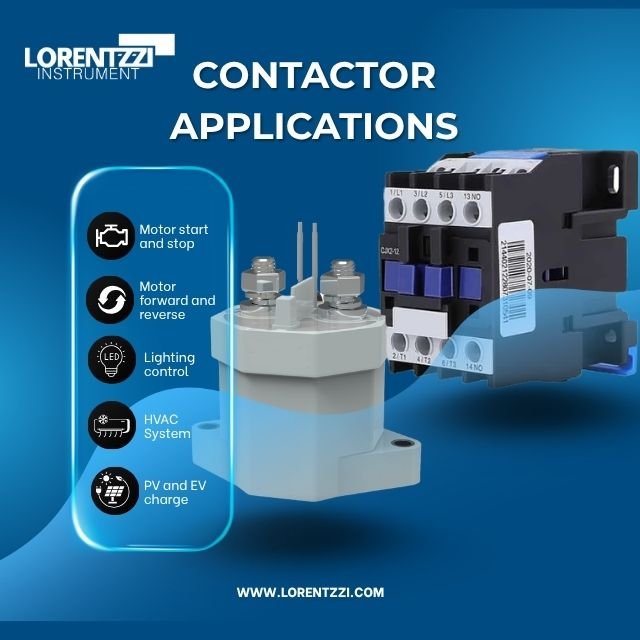
In this blog post, we’ll break down contactor applications from 4 fields: motor start and stop control, motor forward and reverse control, lighting control, and HVAC (heating, ventilation, and air conditioning) systems.
What is a contactor?
A contactor uses a low-voltage safety switch to connect a high-voltage hazardous power source, isolating low-voltage and high-voltage circuits.
Inside the contactor is a coil; once a low-voltage voltage is applied to the control coil, an electromagnetic field is generated, causing the contacts to close or release and control the circuit’s opening or closing.
Motor start and stop control
In motor start-stop control, contactors are essential components.
If you’ve ever used a knife switch to control a motor, you’ll know that sparks are generated when the switch closes to connect the motor.
If an operator is directly exposed and touches these sparks, it can result in electric shock, which is extremely dangerous.
Additionally, there’s a potential risk of electric shock if an operator comes into contact with a three-phase power supply.
Using contactors can avoid these potential hazards and has the following 4 obvious advantages:
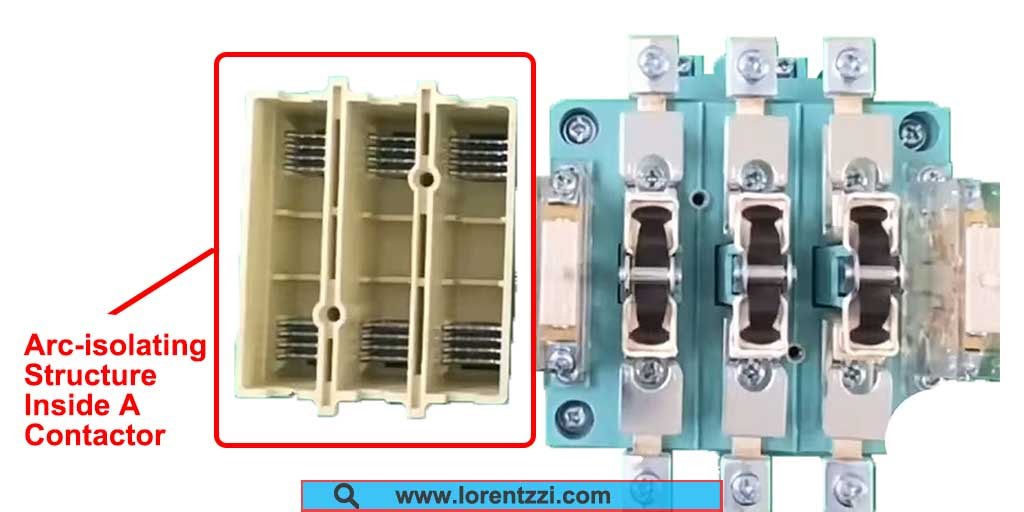
- First, the contactor has an internal arc-isolating structure (For small current contactors less than 20 amps, they use a plastic insulation layer to eliminate the arc; while for large current contactors greater than 20 amps, there is an arc-extinguishing grid to eliminate the arc), which absorbs sparks when the circuit is closed.
- Secondly, when using a contactor, the motor’s closed circuit is entirely controlled by the low-voltage coil. When the coil is energized, it generates electromagnetic force, attracting the main contacts to close, thereby controlling the motor’s start and stop. This effectively isolates the high-voltage and low-voltage circuits, allowing for safe operation by the user.
- Third, contactors can be used to remotely control motors: only a small amount of AC or DC power is needed to remotely control the motor’s start and stop. For example, a microprocessor (such as a PLC) with a small relay can be used to control the energization or de-energization of the contactor coil.
- Fourth, if a contactor with an thermal overload relay is used, the motor can be safely protected from damage caused by overload, short circuit, and overcurrent.
Motor forward and reverse rotation control
In addition to starting and stopping the motor, contactors can also be used to control the forward and reverse rotation of the motor.
The motor can be reversed using only two contactors. The diagram below shows a simplified wiring diagram for these two contactors and one motor.
Let me break down how to achieve it in 4 steps:
1. Connect the 1st contactor to complete the self-locking operation
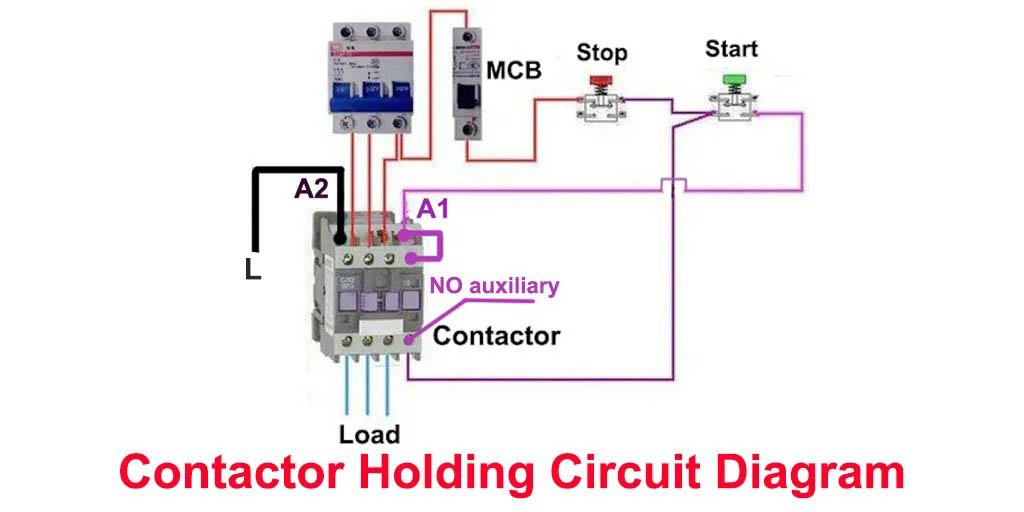
As shown in the image above: First, take the “L” and “N” wires from the MCB. Connect the “L” wire to contactor “A1“, and connect the other “N” wire to terminal “A2“. Simultaneously, take another “L” wire and connect it to another terminal “A2” via the NO auxiliary contact. This operation will achieve self-locking.
2. Connect the 2nd contactor to complete the self-locking operation:
Similar to the wiring diagram for the first contactor, you can connect the second contactor in the same way to achieve the holding function.
3. Connect the two self-locked contactors to complete the interlocking operation:
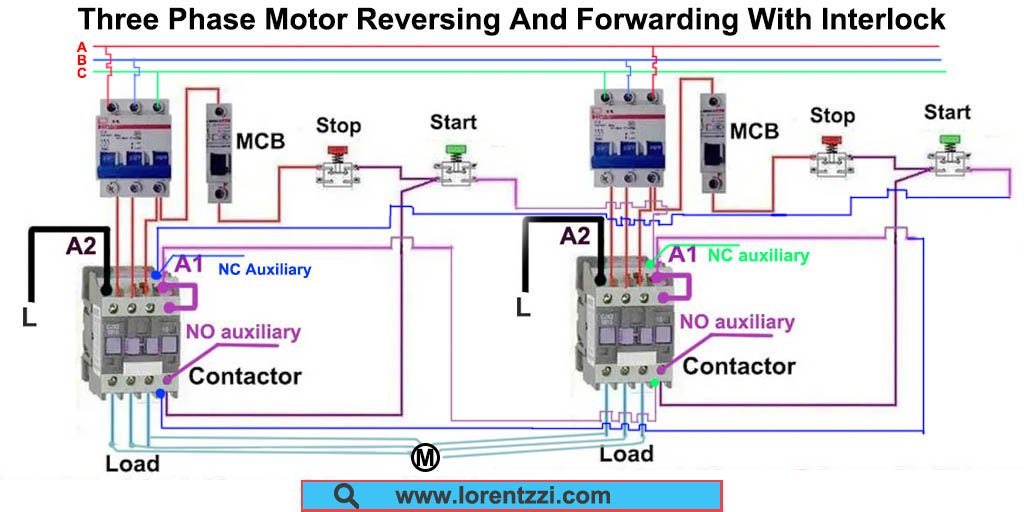
As shown in the diagram above, the interlock function is achieved using the normally closed auxiliary contacts of the two contactors.
Contactor interlocking prevents both contactors from engaging simultaneously to drive a three-phase motor. If their main contacts close at the same time, a severe three-phase short circuit will occur, causing the motor to burn out.
4. Connect the three-phase motor to the contacts of the two contactors:
Finally, connect the terminals of contactors L1, L2, and L3 to the three-phase power supply in the order ABC. For the second contactor, note that the three-phase power supply connection order for its L1, L2, and L3 should be CBA.
Then connect the output terminals T1, T2, and T3 of both contactors to the three-phase motor.
Now, pressing the first start button will rotate the motor forward, and pressing the second start button will rotate it in reverse.
Lighting control
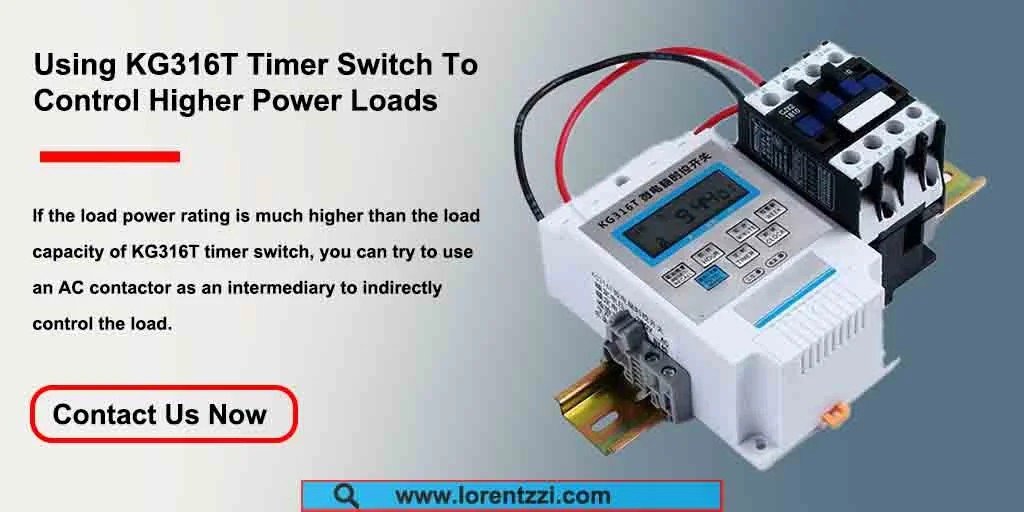
Why are contactors necessary for lighting control?
The answer is simple: because the rated power of LED strips is greater than the contact power of timer switches, indirectly controlling the contactor increases the load capacity of the timer switches.
Fan, heater and compressor control In HVAC
HVAC stands for Heating, Ventilation, and Air Conditioning(Or Cooling).
In building construction, heating, ventilation, and air conditioning (HVAC) systems are very important because good HVAC systems can ensure human health and safety, protect the building structure and interior property, and meet national building and fire protection standards.
In HVAC systems, the main components include heaters, blowers, and compressors, which are primarily controlled by commonly used thermostats or PLCs.
The thermostat is the control core of an HVAC system, coordinating the operation of components such as the fan, heater, and compressor, and automatically adjusting its output based on real-time indoor temperature data feedback:
- Heating Mode: When the indoor temperature is lower than the set value, the thermostat first outputs a signal to start the circulating fan, establishing airflow circulation. It then sends a heating adjustment command to the solid-state relay (SSR) or SCR power regulator, energizing the electric heater to raise the temperature. Hot air is then delivered into the room with the fan airflow. Once the target temperature is reached, the thermostat automatically reduces/cuts off the heating output, while the fan continues to circulate and maintain a uniform temperature.
- Cooling Mode: When the indoor temperature is higher than the set value, the thermostat first starts the circulating fan, then outputs a cooling start signal to the compressor’s dedicated contactor, activating the compressor. The fan is independently controlled and continuously delivers cool air, achieving indoor cooling.
Photovoltaic energy storage system and EV charger
We can also find contactors in photovoltaic energy storage systems and electric vehicle chargers, but these contactors are designed for DC power supplies.
Now let’s look at what a DC contactor is.
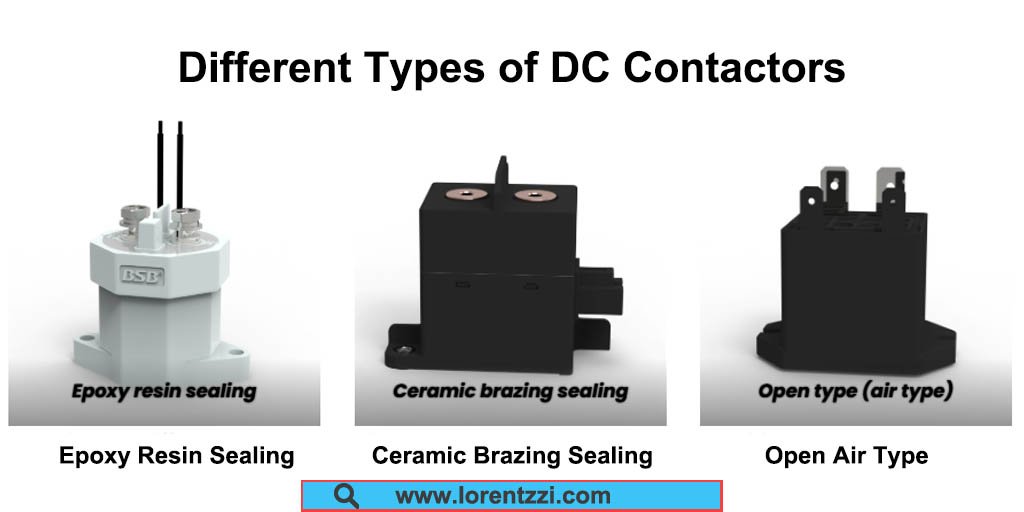
Unlike commonly used AC contactors, DC contactors are specifically designed for high-voltage DC power supplies, with a maximum DC voltage of 2500VDC at their main contacts. Its operating principle is the same as an AC contactor: when a DC power supply is applied to its coil, the main contacts close, allowing the DC power to flow.
Conclusion
In short, the applications of contactors are not limited to the five types mentioned above; in fact, they can be found wherever there is electricity.
If you are now looking for a contactor supplier in China or need technical support, you can contact us for more information. The staff at Lorentzzi Electric are ready to assist you anytime and anywhere!