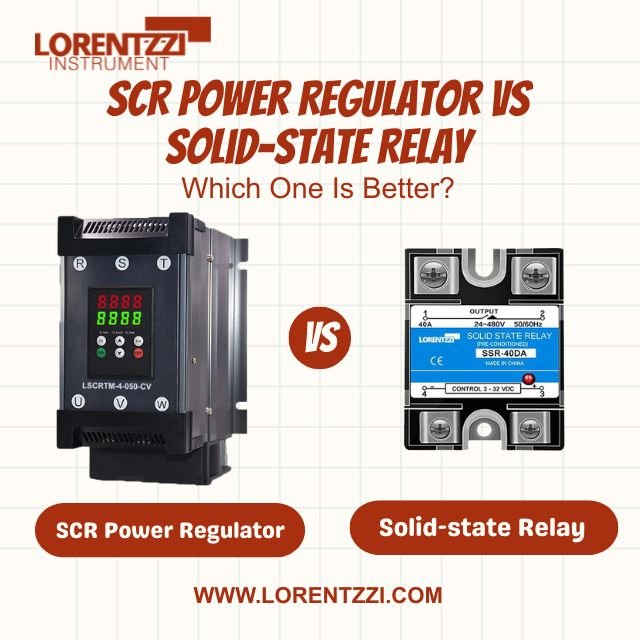
Solid-state relays and SCR power regulators are widely used in heating temperature control systems due to their advantages such as no moving contacts, long service life, and fast response speed.
But do you know the main differences between these two products?
In this blog post, we’ll provide a detailed comparative analysis to help you understand them more deeply.
What is an SCR power regulator?
SCR power regulators are solid-state power control devices widely used in temperature control systems. It linearly regulates the output power of the heating load by adjusting the AC output voltage, thereby achieving precise and stable temperature control.

For example, if your input voltage to the SCR power regulator is single-phase 110VAC or 220VAC, and the control signal of the SCR power regulator is typically 4-20 mA, 0-5VDC, 0-10VDC, or a potentiometer, when you increase the control signal from 0% to 100%, its output voltage will also increase from 0% to 100% accordingly.
For more information on SCR power regulators, you can learn more in our blog post: SCR Power Regulator: What Is It And How It Works.
What is a solid state relay?
Unlike silicon controlled rectifier (SCR) power regulators, solid-state relays are switching devices with only two states: either fully on(100%) or fully off(0%). They do not have intermediate states like 10%, 30%, 50%, and 80% of the input voltage.
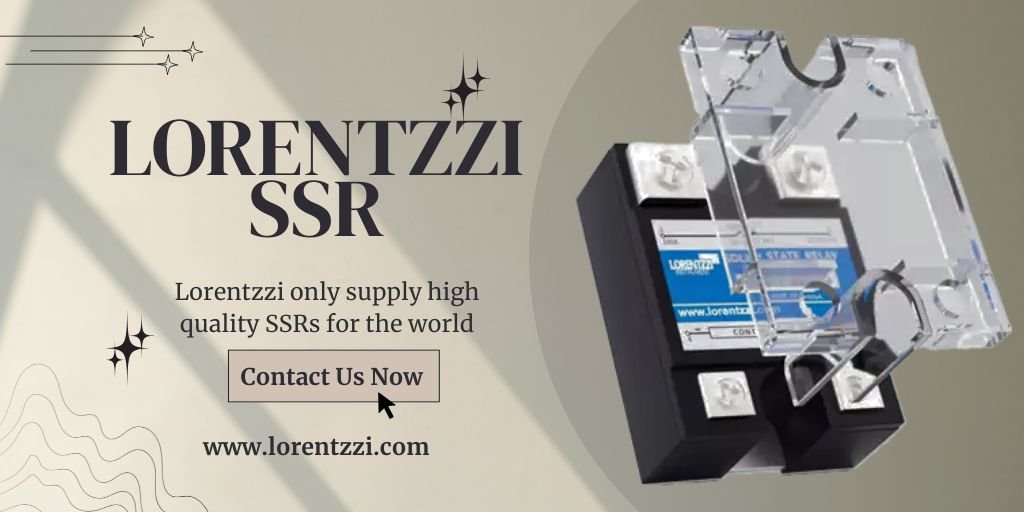
For example, let’s take the SSR-40DA solid-state relay as an example to explain its working principle. When a control signal voltage of 3-32VDC is applied, its 24-480VAC load section will be turned on; after the control signal is removed, the load will be immediately disconnected.
Key differences between the SCR power regulator and solid-state relay
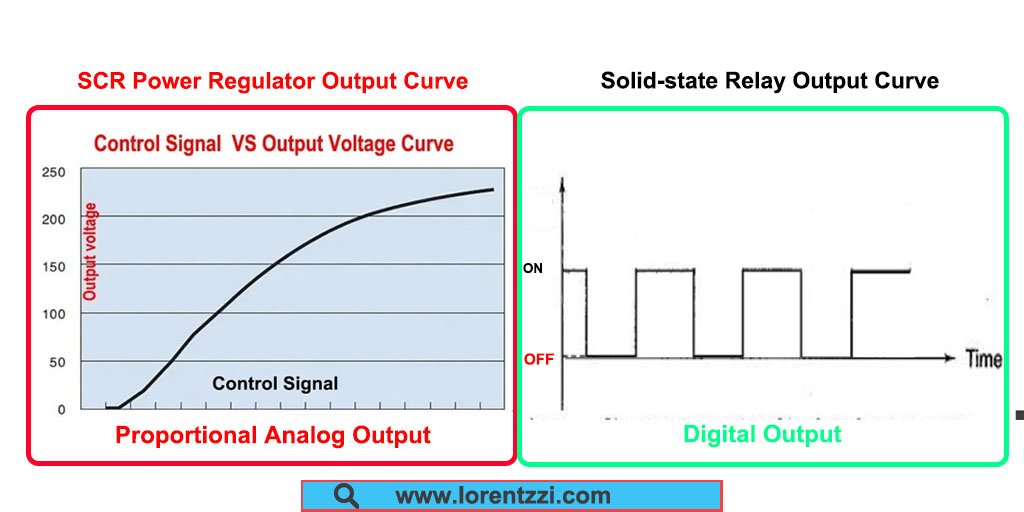
The SCR power regulators and solid-state relay have 12 differences, including control signal, working principle, function, output voltage and so on, we have made a table below for these comparison for your reference:
| Comparison Item | SCR Power Regulator | Solid-State Relay |
|---|---|---|
Control signal |
Analog signals such as 0-5 VDC, 0-10 VDC, and 4-20 mA. |
Digital signal, for instance:
DC/AC solid-state relay: 3-32VDC
AC/AC solid-state relay: 24-280VAC. |
Working principle |
Phase angle control: continuously adjusts output power linearly from 0% to 100%. |
Zero-crossing or random turning on optional: power is only fully turned on or off without proportional adjustment. |
Function |
Closed-loop: constant voltage, constant current, constant power and open-loop optional. |
Open-loop: Simply on/off control. |
Output voltage |
Continuously variable AC output (0~100% of input voltage). |
Fixed full input AC voltage: No output or 100% output of the input voltage. |
Main application |
More precise heating temperature control (plastic extruders, ovens, industrial furnaces, ceramic heating tubes). |
Simple on-off load control (small heaters, lighting, solenoid valves without precise temperature requirements). |
Temperature control accuracy |
Very high. |
Relatively low compared with SCR power regulator and frequent on-off cycling causes obvious temperature swing. |
Price |
High |
Low |
Maximum current |
Wide range of applications: Available from 10A to thousands of amperes, suitable for large industrial temperature control equipment. |
Most are low to medium current (≤200A); ultra-high current models are rare. |
Communication |
SCR power conditioners typically come with communication capabilities, such as an RS485 communication port, so operators can remotely monitor their status. |
Solid-state relays are passive actuators that do not have communication capabilities during production, so operators cannot remotely monitor their operating status. |
All-in-one or not |
Yes, most SCR power regulators are integrated, combining the thyristor, control circuit, heat sink, and cooling fan. Some suppliers even integrate a PID temperature controller into their SCR power regulators. |
Generally, they are split-type. For solid-state relays with large current, heat sinks and cooling fans should be installed to help cool them. Temperature control requires external signal conditioning or a PID controller. |
Weight |
Since most SCR power regulators are integrated units, they are typically much heavier than solid-state relays. |
Very lightweight and compact. |
What are the constant voltage, constant current and constant power of the SCR power regulator?
Lorentzzi high-end SCR power regulators operate in various modes, including constant voltage, constant current, constant power, and open-loop. What do these modes mean? We will explain them in detail below.
Constant voltage
The constant voltage mode is mainly used to deal with external voltage fluctuations.
That is, when the resistance of the power grid or load changes, if the SCR power regulator is working in this mode, it can maintain a constant voltage by means of the PID voltage negative feedback mechanism inside the SCR power regulator.
Constant current
The constant current operating mode is mainly used to maintain the output current of the SCR power regulator to solve problems such as heater aging (Note: After the heater ages, its resistance will increase. Therefore, if the output voltage remains unchanged, the heating efficiency will decrease, which will lead to temperature runaway, resulting in raw material scrapping, product quality degradation, etc.).
The constant current operating mode uses current as feedback. When the load resistance increases, the voltage is automatically increased to maintain a constant current (the current is fixed, and the voltage changes with the load).
Constant power
The constant power operating mode is used to maintain stable voltage and current, which can solve problems such as both voltage fluctuations and heater aging.
When operating in this mode, the SCR power regulator can simultaneously collect voltage and current data to calculate power, and dynamically adjust the product of the two to keep it constant (power is fixed, while voltage and current change dynamically with the load/grid).
How to choose between an SCR power regulator and a solid-state relay?
From a budget perspective, SCR power regulators are always more expensive than solid-state relays for the same output power because they offer more features, such as communication, soft-start and soft-stop, and closed-loop control: constant voltage, constant current, and constant power control.
From another perspective like remote monitoring and temperature control accuracy, the SCR power regulators are a better choice, even though they are more expensive but they can do more work than the solid-state relays.
Simply, if you require more precise temperature control and prioritize the quality of products manufactured by your temperature control system, choose an SCR power regulator; if you have a limited budget and only need simple switching control, a solid-state relay is the ideal choice.
Conclusion
In summary, both SCR power regulators and solid-state relays can be widely used in temperature control systems, but if you require more precise temperature control and more functions, we recommend choosing an SCR power regulator.
Lorentzzi Electric offers high-end 10 amps to 1000 amps SCR power regulators and economical 10 amps to 200 amps solid-state relays or solid-state voltage regulators for your various heating control equipment. If you are interested in purchasing or require a complete solution from us, please email shonxu@lorentzzi.com for details.