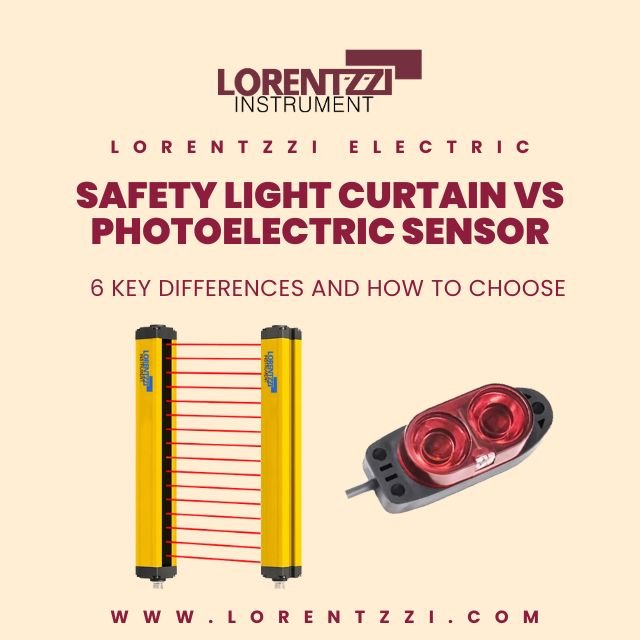
Both safety light curtains and photoelectric sensors use infrared light to detect the presence of objects, but their applications differ: safety light curtains are primarily used to protect personnel from dangerous machinery, while photoelectric sensors are mainly used for simple tasks like object counting and position detection and so on.
Besides this application difference, what other key differences exist between these two types of sensors?
In this blog post, we will explore and introduce 6 key differences between them, including working principles, applications, number of beams, protection zone, reliability, standards, and more.
To clarify the difference between these two types of sensors, firstly we need to know what they are.
What is a safety light curtain?
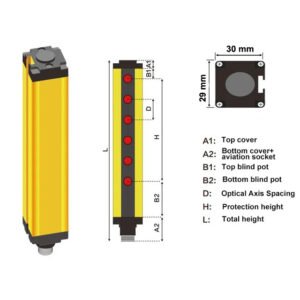

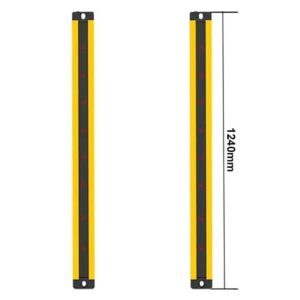
In simple terms, you can think of a safety light curtain as a series of through-beam photoelectric sensors connected in series, which can protect a plane. Therefore, the safety light curtain belongs to the photoelectric sensor.
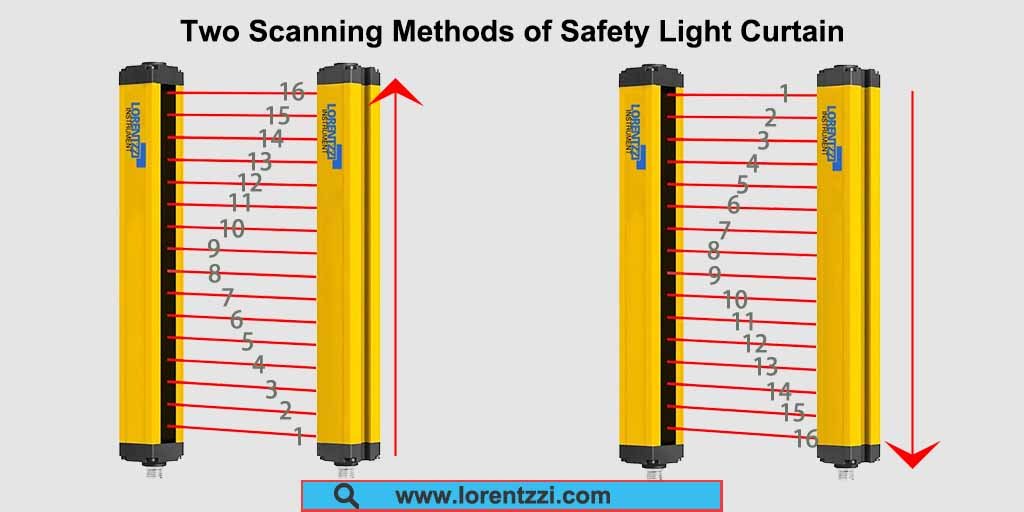
A safety light curtain consists of two parts: a transmitter and a receiver.
The light beam of the safety light curtain changes periodically and scans sequentially; the beam can scan from top to bottom, bottom to top, or cross-scan.
During the scanning process, if any beam is blocked, its output changes from normally closed to normally open, thereby cutting off the power supply to the load and protecting personnel from injury caused by heavy machinery.
What is a photoelectric sensor?
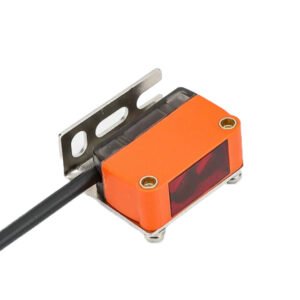

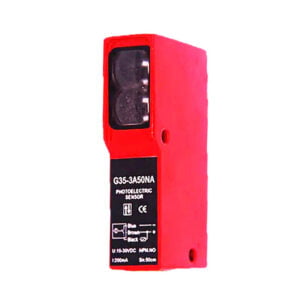
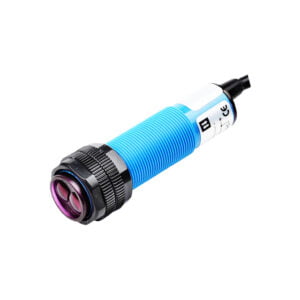
Now let’s have a look at the photoelectric sensors.
Photoelectric sensors also use light for non-contact object detection.
But, they can only sense a line or a point.
Once the light is blocked, the sensor’s state changes, for example, from normally open to normally closed.
If connected to a PLC (Programmable Logic Controller), the PLC can detect this change and control the operation of a motor or solenoid valve according to a preset program, thereby driving the motor or cylinder.
Photoelectric sensors are classified into diffuse, reflective, and through-beam types.
Diffuse photoelectric sensors detect the presence of an object by using light reflected back from it; specular reflective sensors detect objects by whether light is refracted back; and through-beam sensors detect objects by verifying that the light has successfully reached the receiver.
Photoelectric sensors are widely used in food, medical, and other fields.
You can learn more about photoelectric sensor applications by reading this blog post: Photoelectric Sensor Applications: 5 Typical Examples.
6 key differences between safety light curtain and photoelectric sensor
The table below details the comparison and differences between safety light curtains and photoelectric sensors:
| Item | Safety light curtain | Photoelectric sensor |
|---|---|---|
Working principle |
Multiple parallel infrared beams are emitted between the emitter and receiver to form a continuous safety detection zone. If any beam is blocked, a safety stop signal is immediately output, cutting off the machine’s power supply. |
It emits and receives infrared light at a single point; it detects only a single fixed point of light. It determines the presence of an object by light reflection/blocking, outputs only a simple on/off signal, and has no safety forced stop logic. |
Application |
Machinery safety protection: injection molding machines, stamping machines, automated assembly lines, CNC equipment, packaging machinery, and robotic work cells. Used to prevent personnel from entering hazardous moving areas and avoid crushing/injury accidents. |
Counting, object detection, part positioning, material presence checking, conveyor counting, and transparent object recognition. Commonly used in logistics transportation, small-scale automated inspection, and non-safety positioning scenarios. |
Number of beams |
Multi-beam design. More beams = larger protection area. Narrower beam spacing = higher protection accuracy. |
It only supports a single beam; it can only detect a line or a specific point. |
Protection zone |
It can protect one plane or use more safety light curtains to protect more planes. |
The detection point is very small, with only one fixed location; it can only monitor one fixed location and cannot form a large-area safety barrier. |
Reliability |
It adopts a standard-compliant redundant safety circuit design, with optional single-channel or dual-channel safety output. It features self-testing and real-time fault monitoring upon power-on; if a fault occurs, the output can be locked and stopped via a safety relay. |
It features a standard single-loop switch output with no redundant safety design and no mandatory self-testing mechanism. |
Standards |
IEC 61496, Type 2 / Type 4 safety category, ISO 13849-1 PL d/e, CE safety certification |
IEC 60947-5-2; it lacks machine safety level certification and is not recognized as a legal safety protection device. |
How to choose between the safety light curtain and photoelectric sensor
Now let’s look at how to choose between safety light curtains and photoelectric sensors.
If you want to protect personnel from machinery such as stamping machines, presses, and cutting machines, we strongly recommend using a safety light curtain.
It provides planar protection, and if someone blocks the light with their hand or other body part, it immediately cuts off the power to the load, ensuring personnel safety.
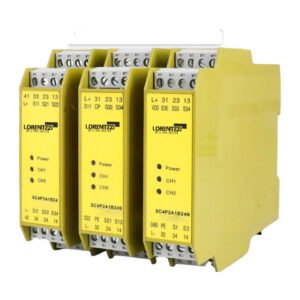
When used in conjunction with a safety relay, it can stop the machine and automatically resume operation after the hazardous activity has been removed, or be manually resumed. Furthermore, it can provide muting operation and blanking functions.
If you only want to count the number of objects on the conveyor belt or perform functions such as position detection, you can use a photoelectric sensor.
Conclusion
In summary, safety light curtains and photoelectric sensors serve different functions. Safety light curtains, besides protecting personnel from hazardous machinery, can also be used for objects counting and other complicated tasks. Photoelectric sensors, on the other hand, are widely used in industrial control for counting and position detection due to their low cost.
If you are looking for high-quality safety light curtains and photoelectric sensors from Chinese suppliers, please send your inquiry to shonxu@lorentzzi.com, and Lorentzzi Electric sales staff will reply as soon as possible.