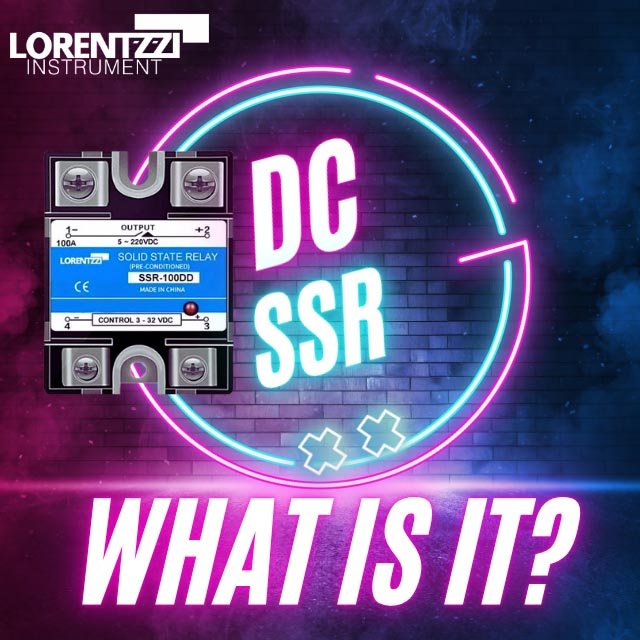
Have you ever wondered how to control a DC heater more safely and easily in a temperature control system?
For Lorentzzi, who has worked in the field of heating controls for many years, the answer is to use a DC solid-state relay, commonly known as a DC SSR.
It has the advantages of no moving parts and fast response time.
In this article, you will learn:
- What is a DC solid-state relay?
- How does it work?
- The advantages of DC solid-state relays
- Applications of DC SSRs
Next, let’s take a closer look at DC solid-state relays.
What is a DC solid state relay?

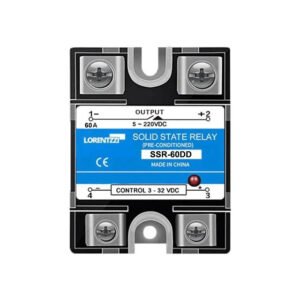
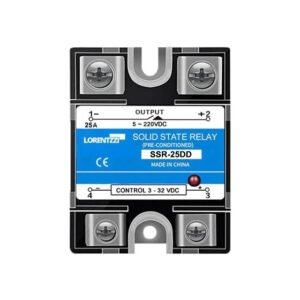
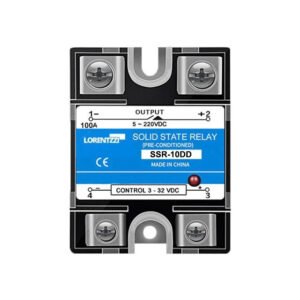
The DC SSR is actually one of many types of SSRs, but it is specifically designed to control DC loads, such as DC heaters, DC pumps, DC motors, and other DC devices.
Its control signal is similar to the most commonly used AC SSR, which is DC3-32V.
Its working principle is very simple: when the control signal is applied and in the range of 3 VDC to 32 VDC, the load part is also closed, turning on the load.
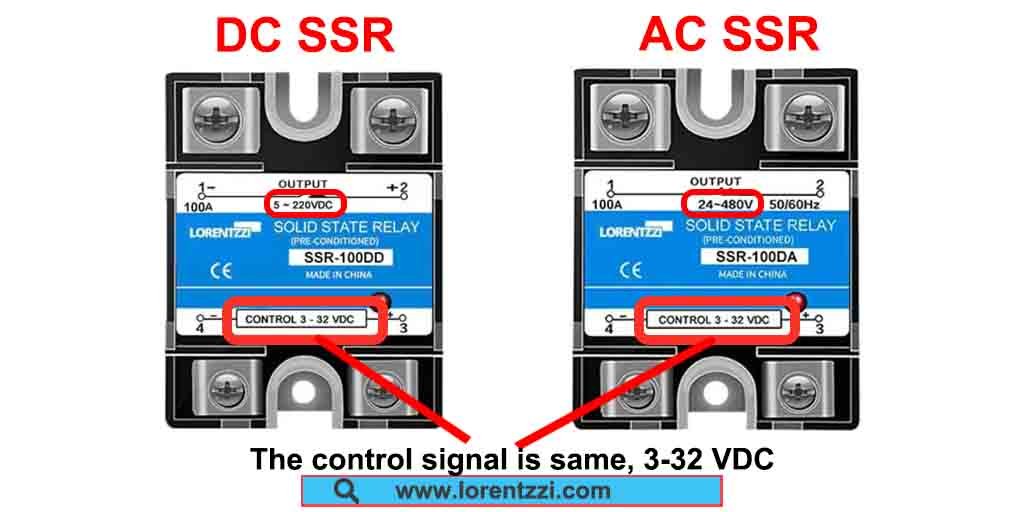
In the next section, we’ll explain in detail how this works.
This feature makes it very suitable for use with PID temperature controllers to accurately control the DC heating elements.
How does it work?
When we talk about the working principle of DC solid state relay, first we need to understand its structure and composition.
The DC solid state relay consists of three parts, namely the input circuit, the isolation part and the output circuit. You can see the simplified composition of the DC SSR in the figure below:
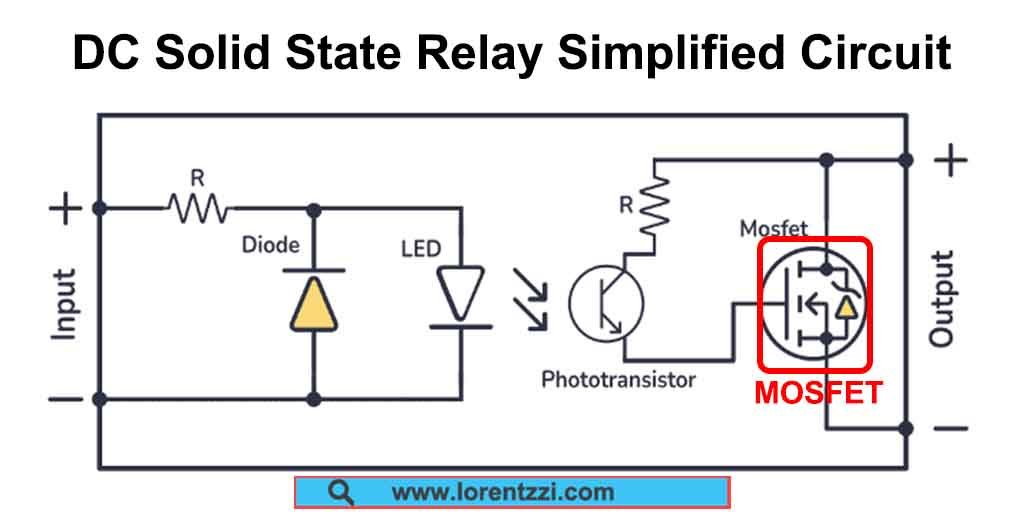
The core component inside a DC SSR is the power MOSFET, which, upon receiving a control signal, can change its conduction state from the off state to the on state, thereby turning on the load.
To explain in more detail, the operation of a DC solid-state relay (SSR) can be divided into two steps:
- When the control voltage is applied, the LED in the optocoupler emits light, which generates a current that activates the phototransistor on the output side of the relay circuit.
- In the output circuit, the driver circuit amplifies the signal and provides enough gate drive current to the MOSFET, turning it on and connecting the load to the power supply.
DC solid state relay advantages and disadvantages
DC solid-state relays have the advantages and disadvantages of ordinary solid-state relays. Below we will explain its advantages and disadvantages in detail:
Advantages:
- No moving parts: Unlike contactors or intermediate relays that use moving contacts to connect loads, DC solid state relays use semiconductor MOSFETs to switch DC loads on/off.
- Fast response time: The response time(less than 30 ns) of MOSFET semiconductor, the core component of DC SSR, is much faster than that of physical switches.
- No need to worry about contact wear: Since there are no moving parts, there is no need to worry about DC SSR contact wear output issues.
- No noise: When the DC solid state relay switches on the load, you will not hear the same clicking noise as with contactors or intermediate relays.
- Long life: If the DC solid-state relay can be used under good heat dissipation conditions, its service life can be said to be unlimited.
- No contact arcing, low EMI, high surge capability.
- Strong resistance to shock and vibration: Lorentzzi® brand solid state relays are fully embedded in the housing material and covered with epoxy resin internally, and since they do not use any moving parts, they are highly resistant to vibration and shock.
- Strong resistance to the chemical corrosion and dust: The DC SSR internal PCB and components are enclosed in a tight enclosure so sand, dust and corrosive chemicals cannot interfere with the trouble-free operation of the solid state relay.
Disadvantages:
- High heat generation: Similar to chips, DC SSR will generate a lot of heat when running for a long time, so it usually needs to be used with a passive heat radiator or an active fan to help cool it.

- The product is too large: As the DC SSR current increases, the size of the matching SSR heat sink product will also increase accordingly, so the problem arises that the larger the SSR current, the larger the entire product set.
DC SSRs applications
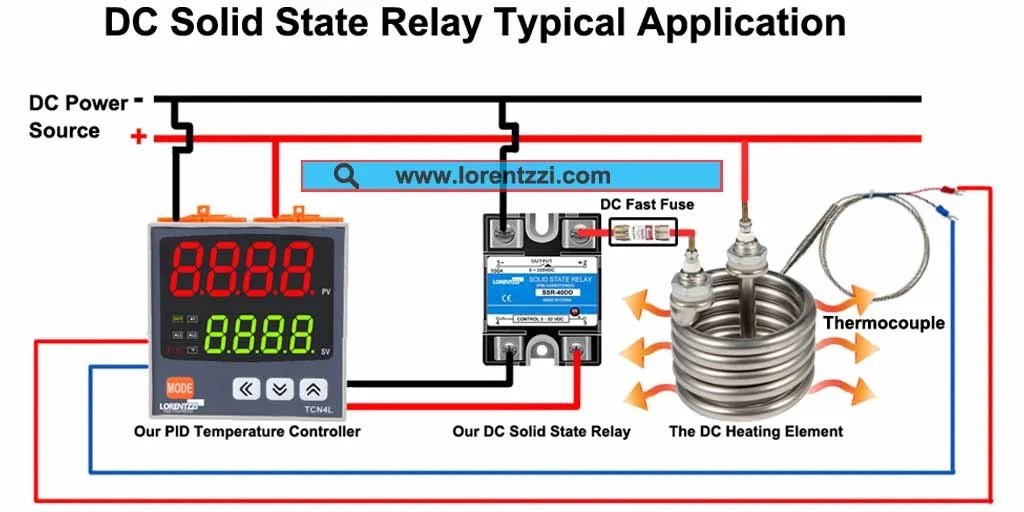
DC solid state relays (SSRs) have many applications, such as control of DC heating heaters in DC temperature control systems, DC light on/off control applications, DC motor start and stop control, battery management systems, photovoltaic systems, etc.
Conclusion
In summary, the DC solid state relay is a semiconductor type switch mainly used to control DC loads. Compared with traditional physical switches, it has many advantages, such as fast switching speed and durability.
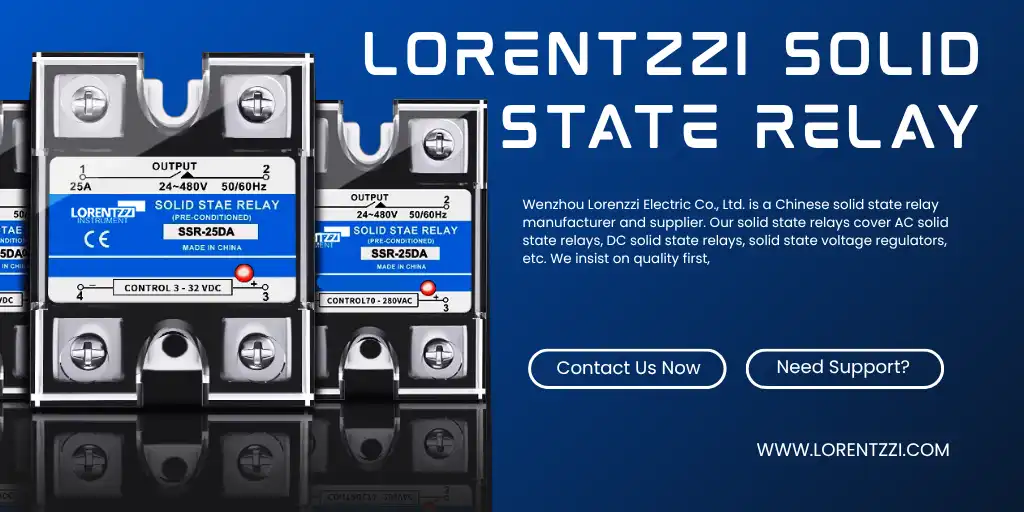
At Lorentzzi, you can find a wide range of DC solid state relays (SSRs) from 10 amps up to 120 amps, with screw-on or DIN rail mounting options. If you would like to learn more about DC solid state relays or get our latest prices, please contact us or send an inquiry to shonxu@lorentzzi.com.