
Choosing a reputable safety light curtain supplier is important, but knowing how to wire the safety light curtain is another matter entirely. Therefore, this article will detail the wiring methods for safety light curtains.
This tutorial includes wiring instructions for three types of safety light curtains:
- NPN safety light curtain,
- PNP safety light curtain,
- Relay output safety light curtain.
Now let’s begin.
NPN safety light curtain wiring diagram
Similar to our photoelectric sensors or other types of proximity sensors, safety light curtains typically offer NPN and PNP transistor outputs as well as voltage-free relay contact outputs.
Before providing the wiring diagram for an NPN output safety light curtain, we first need to understand its operating principle.
For safety reasons, the output circuit of a safety light curtain is typically designed in normally closed (NC) mode. Therefore, its working principle will be as follows:
- When the beam is not blocked (normal state): the internal NPN transistor is turned on (remains normally closed), and the output terminal (black wire) is 0V to ground.
- When the beam is blocked (triggered state): The internal NPN transistor is turned off(the circuit changes from normally closed to normally open), and the output terminal is disconnected from 0V. At this time, the output is in a floating state. If a pull-up resistor is connected in the external circuit (for example, connected to a PLC input), the output will become 24V.
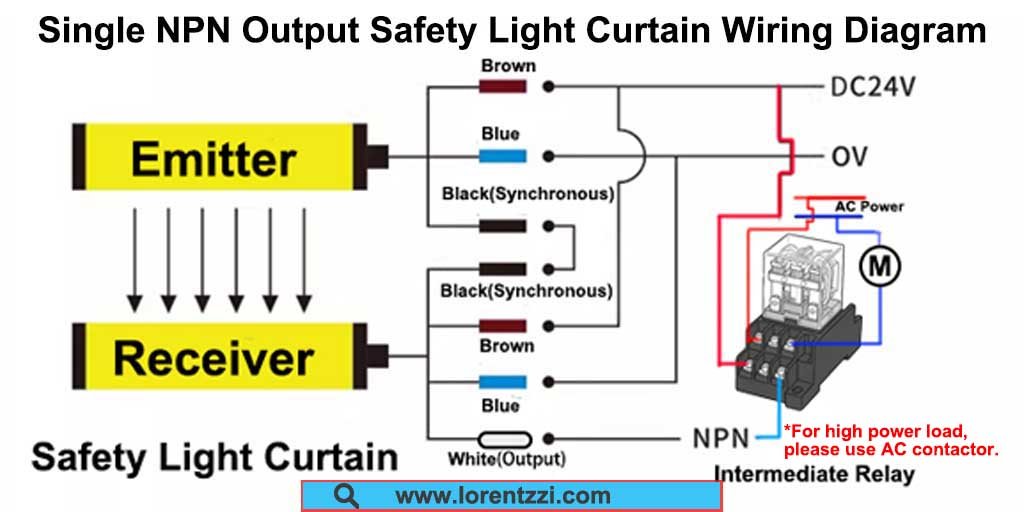
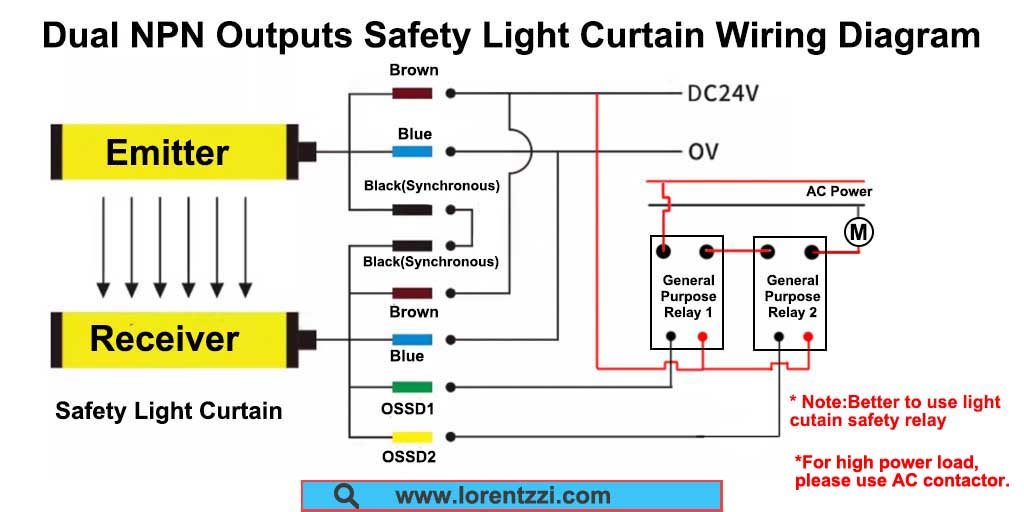
So, you can see the following NPN safety light curtain wiring diagram:
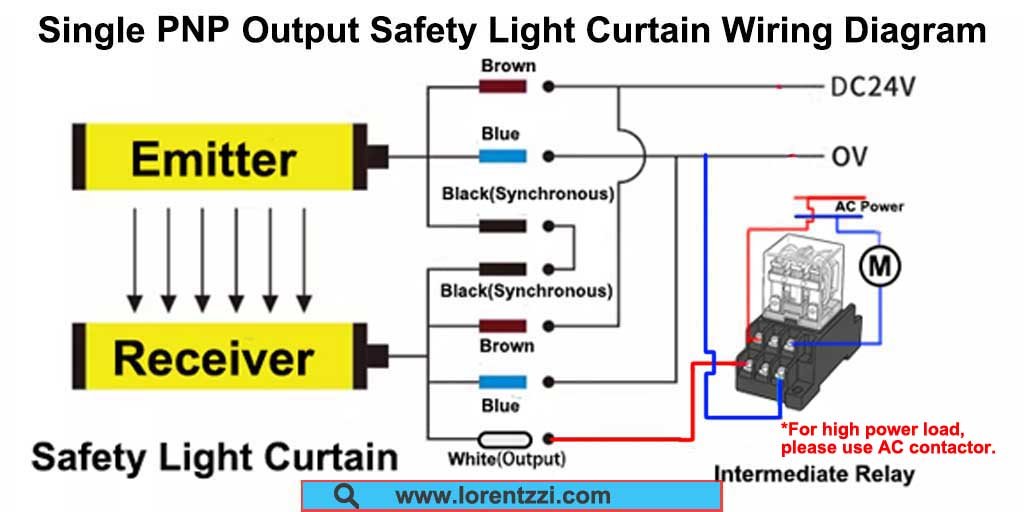
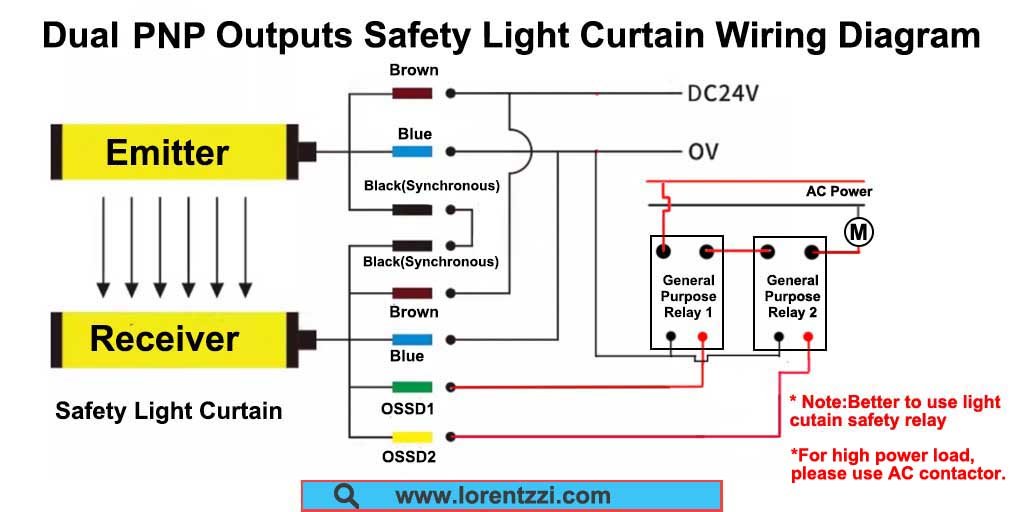
PNP safety light curtain wiring diagram
Conversely, the safety light curtain output by a PNP transistor is completely different from the safety light curtain output by an NPN transistor.
It should be noted that the synchronization methods for safety light curtains are divided into optical synchronization and line synchronization. The advantage of optical synchronization is that it saves on wiring, but the disadvantage is that it is easily affected by strong light. The advantage of line synchronization is that it is stable and is not affected by strong light, but the wiring is slightly more complicated and requires additional cables.
And the PNP safety light curtain working principle is:
- When the beam is not blocked (normal state): The internal PNP transistor is initially turned on (remains normally closed), and the output (black wire) is +24VDC (high level) to ground.
- When the beam is blocked (triggered state): The internal PNP transistor is initially turned off, and the output terminal is disconnected from +24V. At this time, the output is in a floating state. If a pull-down resistor is connected in the external circuit (e.g., connected to a PLC input), the output will become 0V.
Therefore, you can see its wiring diagram as following:
Relay output safety light curtain wiring diagram
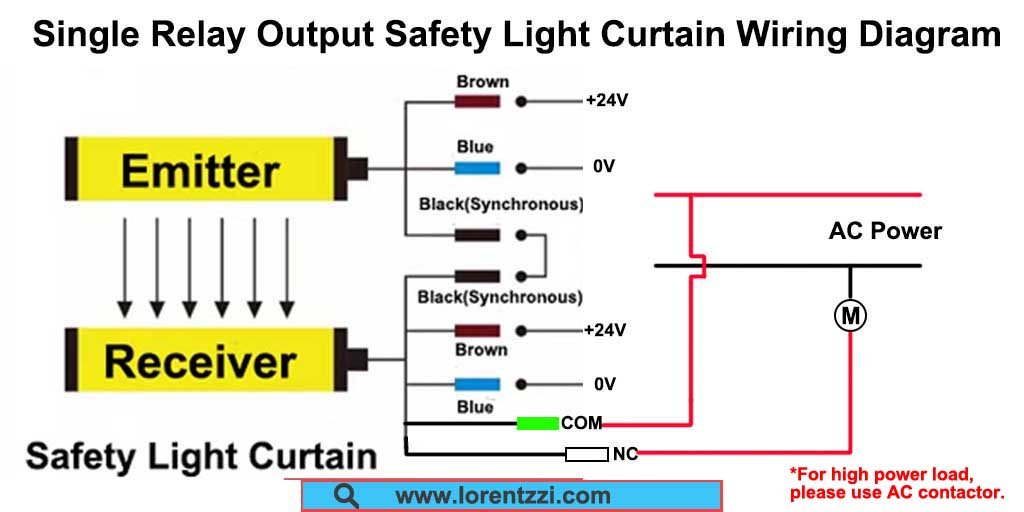
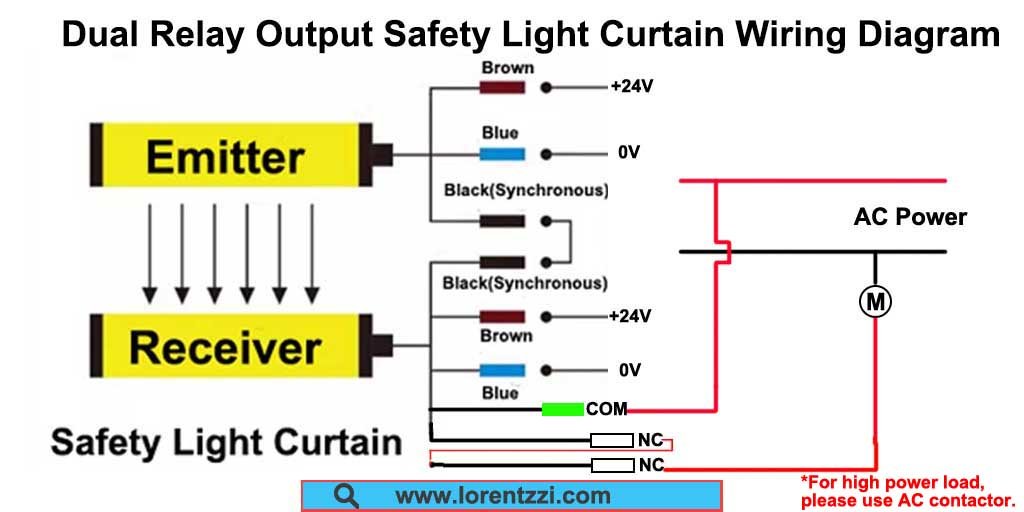
If the output of a safety light curtain is a relay type, it functions as a voltage-free (dry) contact switch. Without an external power supply connected to these relay outputs, it can only open or close the circuit, but cannot provide trigger voltage or current to the controlled unit.
Therefore, for a safety light curtain with relay output to operate correctly, an external power supply must be applied to its relay output terminals.
The relay output safety light curtain working principle is as following:
- If the beam is not blocked, the circuit remains closed, and the machine can operate normally.
- When the beam is blocked, its contacts will change from normally closed to normally open, thereby cutting off the external power supply to the coil of the general-purpose relay or AC contactor, and thus shutting down the motor or other actuators.
The wiring diagram for the relay output safety light curtain is as follows:
Can I use general purpose(intermediate) relays with the safety light curtain?
A general-purpose(intermediate) relay is a device that uses a small control signal to control high voltage and high current. Therefore, by connecting the output of a safety light curtain to the control signal terminal of a general-purpose relay and connecting the controlled part to a small load or coil of an AC contactor, the machine can be started and stopped.
Therefore, for single-output or dual-output safety light curtains, one or two general-purpose relays can be used together, but this is less safe than a light curtain safety relay and does not comply with functional safety standards (e.g., ISO 13849, IEC 62061).
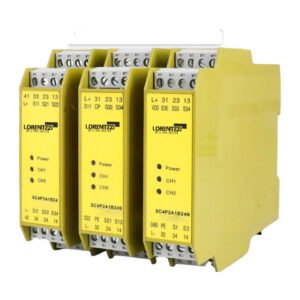
In summary, although a general-purpose relay can be used in conjunction with a safety light curtain to stop the machine and protect operators, it is strongly recommended to use a light curtain safety relay to avoid potential risks to personnel, as it offers higher reliability.
Conclusion

In summary, before wiring a safety light curtain, you need to determine its output type: NPN transistor, PNP transistor, or relay output, and whether it’s a single or dual output. Dual outputs typically provide redundancy and backup protection, but the wiring will be slightly more complex.
If you still have questions about wiring a safety light curtain, please contact us, Lorentzzi Electric, for more free technical support.