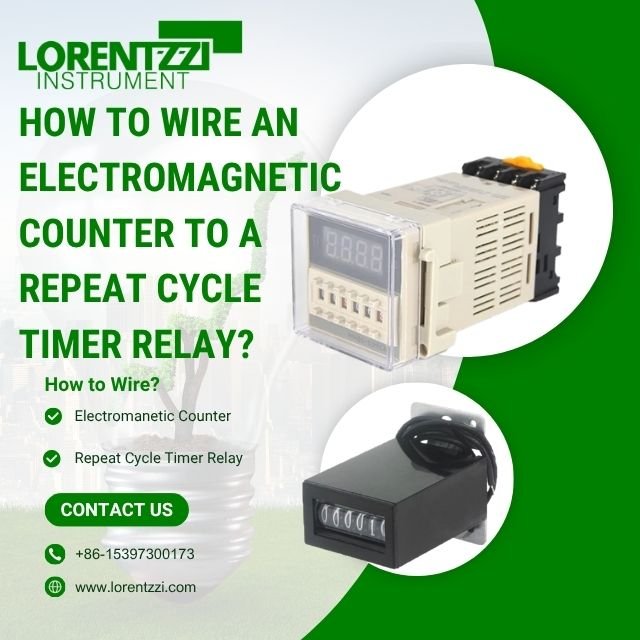
Can electromagnetic counters (such as our LMC-06 6-bit or CSK6-YKW electromagnetic counter) be used with repeat cycle timer relays (such as our DH48S-S timer relay, H3CR-8 knob type timer relay or TMM1 multifunction time relay) to achieve specific functions such as counting the number of cycles?
The answer is yes, but how to wire these two products is another matter.
Therefore, in this blog post, we will provide you with a complete guide covering:
- What are electromagnetic counters and repeat cycle timer relays?
- How to connect them?
- Why wire them?
Let’s delve into this together.
What is an electromagnetic counter?
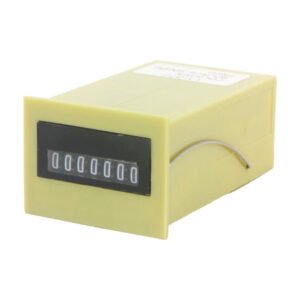
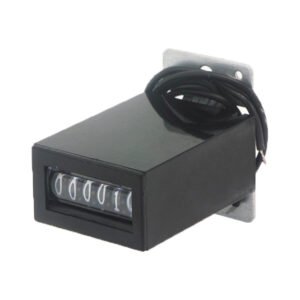
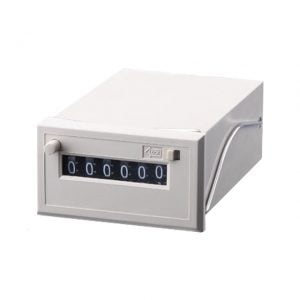

An electromagnetic counter is a mechanical counting instrument used to measure the number of applied voltage pulses.
Its working principle is very simple: when an external input voltage signal is applied to the electromagnetic counter, its internal coil is energized, generating a magnetic field.
The magnetic field drives or pulls a lever, which in turn rotates a gear, thus displaying the number of counts.
This operation is repeated each time the counter is powered on, thus calculating the number of times the voltage is applied.
What is a repeat cycle timer relay?
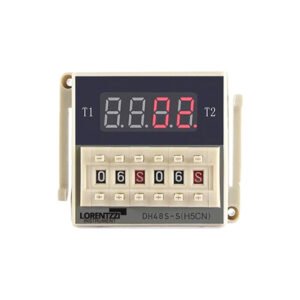
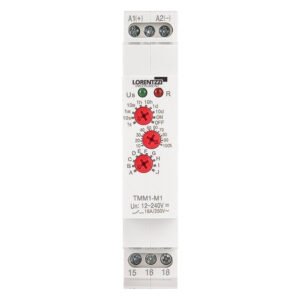
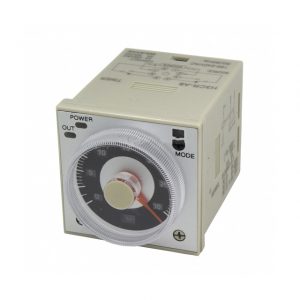
A repeat cycle timer relay (also called a cyclic timer relay) can cyclically close and open a controlled circuit, causing the load to start and stop repeatedly.
For example, our DH48S-S is a typical and commonly used DIN rail cyclic timer relay. By setting T1 and T2, you can perform cyclic off/on operations according to the set times of T1 and T2.
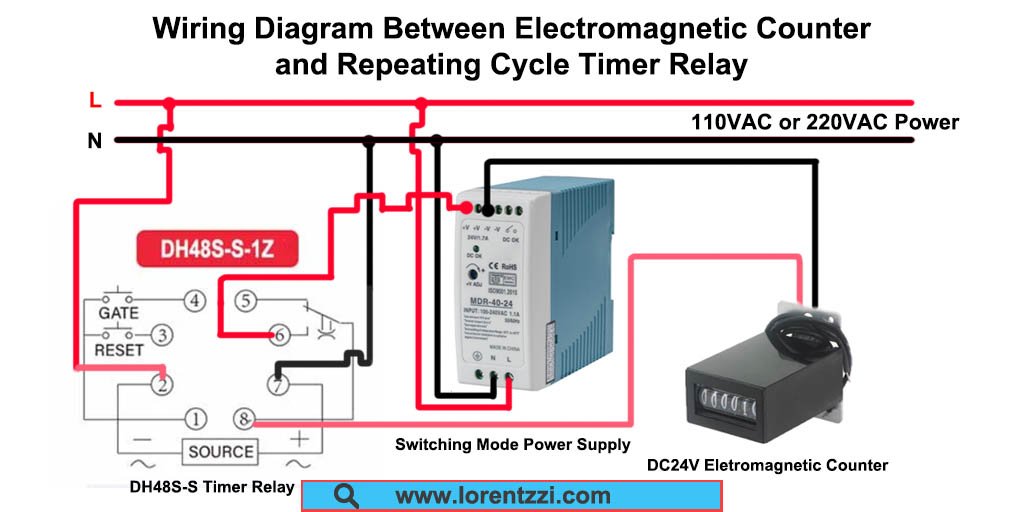
If the load is connected between terminals 6 and 8, an external power supply is required because these contacts are dry contacts.
If the external power supply and the load are connected in series between terminals 6 and 8, then the load will operate during the time set for T2, and will not operate during the time set for T1, and so on in a cyclic manner.
How to wire an electromagnetic counter to a repeat cycle timer relay?
Because electromagnetic counters use the magnetic field generated by a coil to attract a metal rod, causing the displayed numbers to scroll, their terminals typically do not have positive or negative polarity. Even if reversed, the magnetic field generated by the coil remains, and the counter will still count normally.
This makes wiring the electromagnetic counter very simple. You only need to supply power to the two terminals of the electromagnetic counter, and it can count the input voltage signal.
Now let’s look at how a repeat cycle timer relay works, using our DH48S-S time relay as an example: After setting the on/off time via the buttons on the front panel, it can repeatedly perform the on/off operation.
Now, if you power it on, it will cycle through closing and opening its normally open contacts, and you can hear it making a clicking sound.
Our DH48S-S timer relay’s NO output is a dry contact; you can simply think of it as a switch. It cannot directly power the load, so to use this contact, you need to connect an external DC or AC power source through it.
Having read the above, we believe it should now be clear how to connect an electromagnetic counter to a repetitive timing relay.
To further clarify the wiring method, we will draw a diagram below to demonstrate the wiring:
Why do we need to wire them?
There are 4 reasons to wire the electromagnetic counter and repetitive time relay together, see below:
1.Count the number of batch productions
For example, the DH48S-S timer relay is used in plastic bag sealing machines. A complete cycle consists of 3.5 seconds of on and 3.5 seconds of off. To count daily output, its output contacts can be connected in parallel with an electromagnetic counter and a controlled load to calculate the number of sealed bags.
2.Equipment lifespan management
For example, the DH48S-S timer relay can be used to control each extension and retraction cycle of the hydraulic cylinder. By reading the cycle count recorded by the electromagnetic counter, users can know the number of cycles and replace the seals in a timely manner, thereby reducing the probability of sudden failures.
3.Stable control of process quality
In addition, the DH48S-S timer relay can be used to control alternating lighting and dust removal: by reading the statistical count through an electromagnetic counter, the number of daily cycles can be limited to avoid long-term overload and aging of the equipment, and to ensure consistent working time each time.
4.Product durability aging test
The DH48S-S cyclic timer relay, used in conjunction with an electromagnetic counter, can be used for aging tests of switches, lamps, and heating elements. It enables continuous cyclic switching, records the total number of cycles before failure, and generates a lifespan report. It can also be used for alternating hot and cold testing of temperature control and water circulation equipment, accurately counting cycle periods, standardizing testing procedures, and eliminating human counting errors.
Conclusion
In short, once you understand how electromagnetic counters and cycle time relays work, connecting them is not difficult.
By connecting these two products, we can calculate batch production quantities, manage equipment lifespan, control process quality stability, and conduct product durability aging tests.

If you still have questions or would like to purchase repeat cycle timer relays and electromagnetic counters from a reliable supplier, you can send your inquiry to shonxu@lorentzzi.com. Lorentzzi Electric‘s sales will reply to your inquiry as soon as possible within 24 hours!