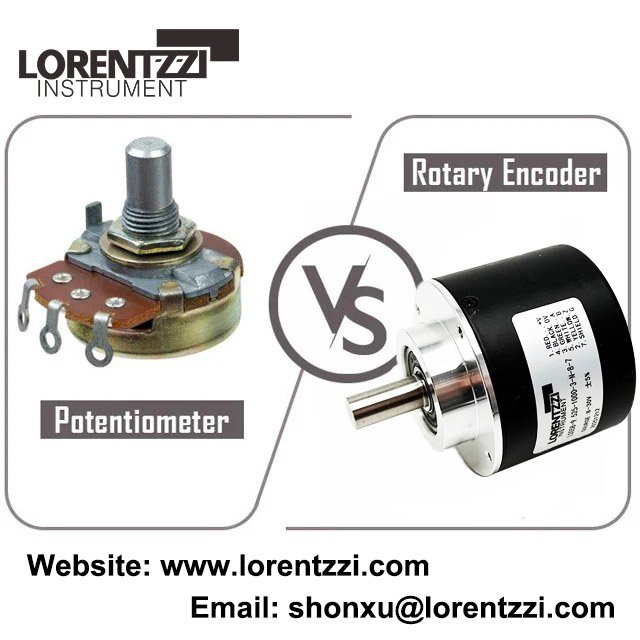
When you need to measure rotation angles, there are two products to choose from: rotary encoders and potentiometers. These two products work on completely different principles and have very different applications.
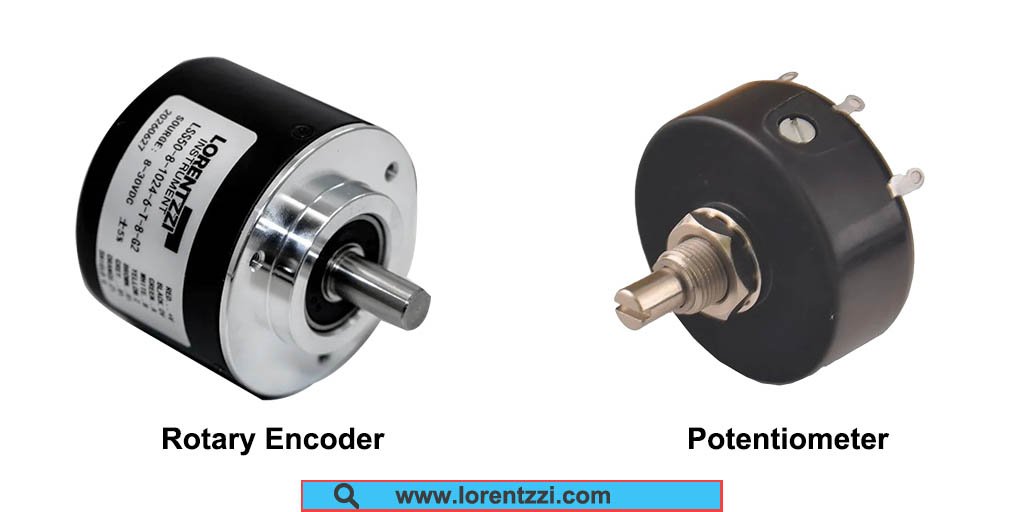
In this blog post, we will walk you through from the following 4 aspects in detail:
- What are rotary encoders and potentiometers?
- The main differences between them.
- The advantages and disadvantages of these two products.
- How to choose a rotary encoder and potentiometer.
What is a rotary encoder?
A rotary encoder is a sensor used to measure the rotation of objects. It converts rotation angle, direction, or speed into measurable electrical signals through optical (e.g., our optical incremental encoders), magnetic (magnetic scales, magnetic rotary encoders) or mechanical means.
Rotary encoders are widely used in industrial automation control systems and instrumentation.
What is a potentiometer?
A potentiometer is a variable resistor. We can use it to adjust resistance, divide voltage, or use it as a position sensor to output an analog signal proportional to angle/displacement.
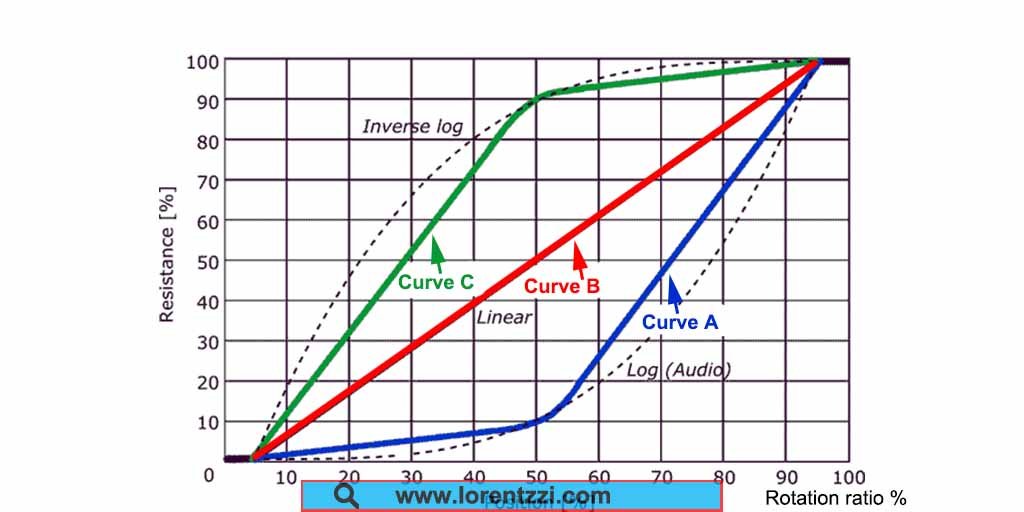
Potentiometers have three output curves (see the figure below), the most commonly used being curve B, which means that when the potentiometer is rotated proportionally, the output resistance will increase or decrease linearly.
It mainly consists of a resistive element, a sliding contact (brush), and a rotating shaft. The rotating shaft moves the sliding contact along the resistive element, thereby changing the resistance value in the circuit.
Potentiometers are widely used in electronics (for example, our SSR-VA series solid-state voltage regulators can be controlled by a potentiometer), electrical engineering, and automation control.
Key differences between rotary encoder and potentiometer
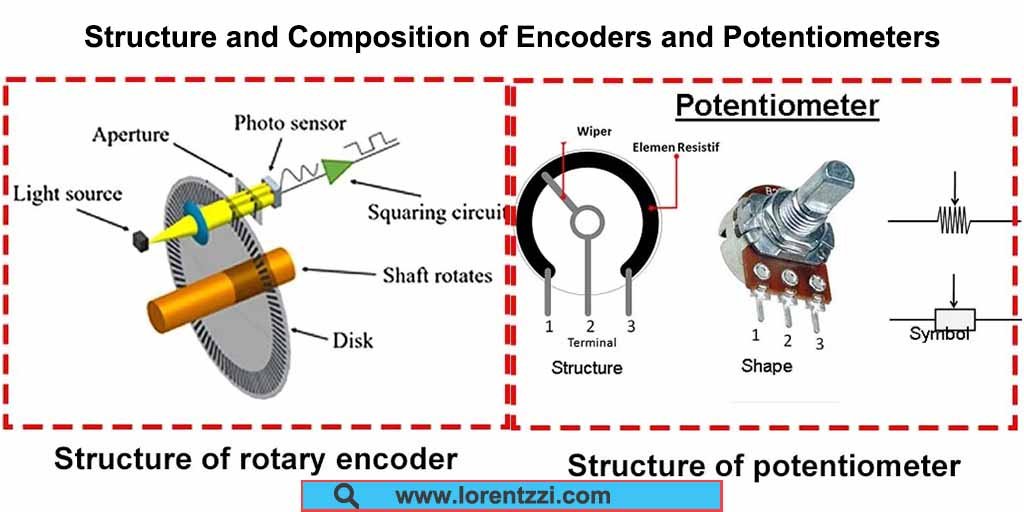
The main differences between rotary encoders and potentiometers are reflected in seven aspects: working principle, signal output, power-off memory, vibration resistance, whether power supply is required to read position information, rotation range, and cost.
The table below clearly compares these two products:
| Item | Rotary encoder | Potentiometer |
|---|---|---|
Working principle |
Optical rotary encoders use light to detect rotation angle, speed, and direction, while magnetic rotary encoders use magnetic fields to detect rotation angle, speed, and direction. |
The potentiometers use the magnitude of resistance to measure the angle of rotation. |
Signal output |
Digital pulse signals (A/B/Z or A/A-/B/B-/Z/Z-/ quadrature pulses) |
Proportional resistance analog signal |
Power-off memory |
Incremental rotary encoders do not have position memory function, while absolute rotary encoders have memory function in case of power failure. |
The potentiometer will remain in its initial position, and the rotation angle information can still be read. |
Vibration resistance |
Strong vibrations can damage the internal glass code disk, causing the rotary encoder to malfunction. |
It can withstand sudden, strong vibrations. However, continuous, high-frequency, strong vibrations will lead to accelerated wear. |
Is an external power supply required? |
Yes, the rotary encoder requires an external power supply. |
If you only need to read the resistance value, no external power supply is required. |
Rotation range |
For incremental encoders: infinite continuous rotation, while absolute encoders have a limited number of rotations. |
The rotation angle is limited (typically 0 – 270° or 0 – 300°). |
Cost |
Rotary encoders are more expensive than potentiometers. |
They are much cheaper than rotary encoders. |
Advantages & drawbacks of rotary encoder and potentiometer
Advantages & disadvantages of rotary encoder
Advantages: Rotary encoders offer high measurement accuracy (e.g., our encoder resolution can reach 10,000 PPR: 10000 PPR Encoder, Optical Incremental Hollow Shaft Type) and are not limited by rotation speed. They are primarily used for speed and rotation direction measurement. For applications requiring rotation angle measurement, absolute encoders can be considered.
Disadvantages: Incremental encoders lose position information after power failure; they require zeroing after each operation; photoelectric encoders are sensitive to severe vibrations; and their overall cost is relatively high.
Advantages & disadvantages of potentiometer
Advantages: The output is a proportional analog resistance signal. No reset to zero is required after power failure. Simple wiring, low cost, and strong shock resistance make it ideal for high-vibration environments (such as damper position indication systems).
Disadvantages: The potentiometers have low measurement accuracy and are easily affected by temperature and external interference (compared to our line driver incremental encoder), and will wear out with long-term use.
How to choose a rotary encoder and potentiometer.
A rotary encoder is a suitable choice when you have the following needs:
- You need continuous, unlimited rotation to measure rotation angle, speed, and direction.
- Your control system requires high-precision measurement.
- The operating environment should not contain continuous high-frequency vibration.
A potentiometer is a suitable choice when you have the following needs:
- Rotation angle range within a full circle (≤ 300°).
- It can read data without an external power source, making it suitable for power-free applications.
- Low cost.
Conclusion
In summary, if you have a limited budget and want to measure rotational angle or displacement without an external power supply, a potentiometer is a good choice; if you need to measure not only rotational angle but also rotational speed and direction, a rotary encoder is the better option.
As a leading manufacturer and supplier of optical rotary encoders in China, Lorentzzi Electric offers high-performance optical incremental rotary encoders. If you are looking for high-quality incremental rotary encoders, please send your inquiry to shonxu@lorentzzi.com.