
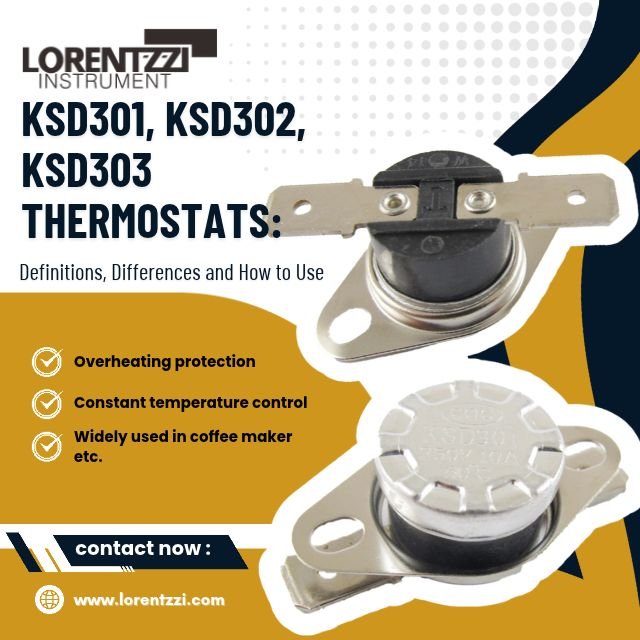
Do you know why a thermos kettle can maintain a constant temperature without failure?
The reason is simple: thermos kettles can automatically shut off and restart because they have a built-in KSD301, KSD302, or KSD303 normally closed contact thermostat. When the water temperature reaches the set temperature, the thermostat cuts off the power and stops heating. When the temperature drops below the set temperature, it resumes heating, and this process repeats.
To better understand the KSD301 and KSD302 thermostats, we will introduce them in detail from the following 4 aspects:
- What are KSD301, KSD302 and KSD303 thermostats?
- What are their main differences?
- How to use KSD301, KSD302 and KSD303 thermostats?
- Typical applications of KSD301, KSD302 and KSD303 thermostats.
Now let’s answer these questions one by one.
What are KSD301, KSD302 and KSD303 thermostats?
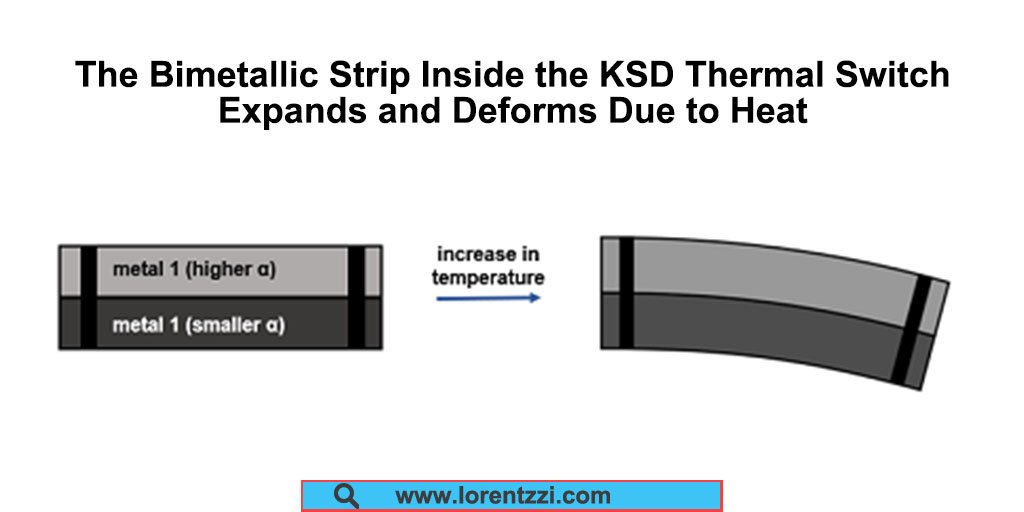
KSD301, KSD302, and KSD303 are common bimetallic thermal switches. When the temperature reaches a set value, the bimetallic strip deforms due to heat (thermal expansion and contraction), causing the contacts to close or open. KSD301 and KSD302 are widely used in electrical equipment for water temperature regulation, preventing dry burning, and overheat protection.
These thermal switches offer a wide adjustable temperature range, from 0°C, 20°C, 40°C, 65°C, 80℃, 100℃ to maximum 300°C.
They support two contact modes: normally closed (NC) and normally open (NO).
For heating devices such as electric kettles, the normally closed KSD301 or KSD302 thermostat is a typical choice. When the temperature reaches the preset value (e.g., 100°C), the thermostat switches from the closed state to the open state, disconnecting the heating circuit. After the temperature cools below the set threshold, the contacts close again, resuming heating.
For cooling fans or refrigeration systems, normally open KSD301/KSD302 thermal switches are used for over-temperature protection. For example, a 40°C KSD301 thermostat can be installed at the bottom of the heating chamber. Once the temperature exceeds 40°C, the thermostat contacts close, and the fan automatically starts, thus protecting internal components from overheating damage.
Key differences between KSD301, KSD302 and KSD303 thermal switches
When purchasing KSD series snap action thermostat, suppliers always ask which model you prefer: KSD301, KSD302, or KSD303? They are very knowledgeable, but what are the main differences between these three models of thermostats?
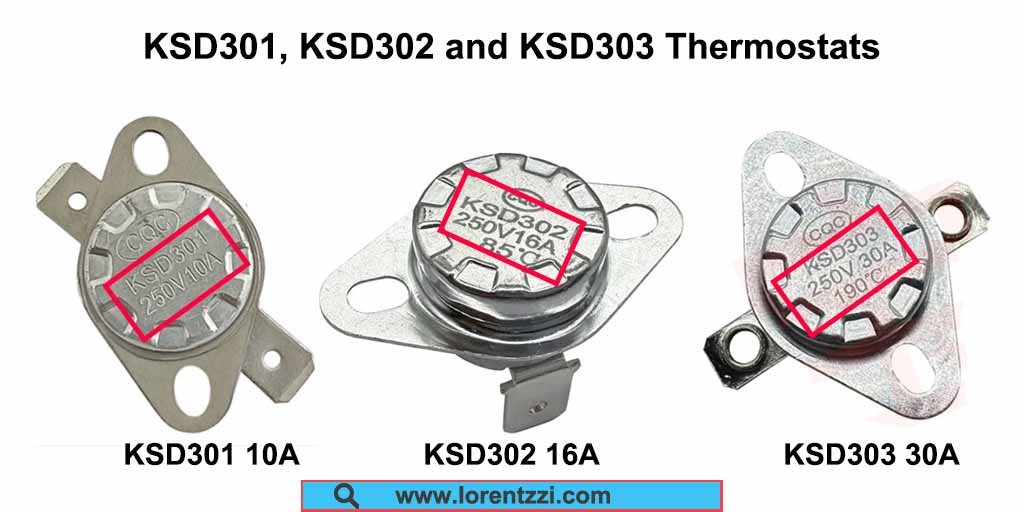
The main difference lies in their contact rated current/load capacity.
- KSD301: Rated contact current 10A,
- KSD302: Rated contact current 16A,
- KSD303: Rated contact current 30A.
You need to select the appropriate model based on the rated power of your heater, refrigeration equipment, or other equipment.
- KSD301: Suitable for resistive loads up to 1.5 kW@220VAC,
- KSD302: Suitable for resistive loads up to 2.0 kW@220VAC,
- KSD303: Suitable for resistive loads up to 3.5 kW@220VAC.
For higher power loads exceeding the above ranges, use the KSD thermostat with a solid-state relay or AC contactor.
How to use KSD301, KSD302 and KSD303 thermostats?
Using KSD series thermal switches correctly can help you achieve proper temperature control and protect your equipment from overheating hazards.
Based on our experience, the following 4 steps should be followed.
Step 1: Choosing the right KSD301, KSD302 and KSD303 thermostats
1. Choose a suitable temperature
The KSD301, KSD302, and KSD303 are fixed-temperature control switches, completely different from PID temperature controllers which offer more flexible temperature control.
Therefore, when selecting the appropriate switch, the first step is to choose the appropriate temperature.
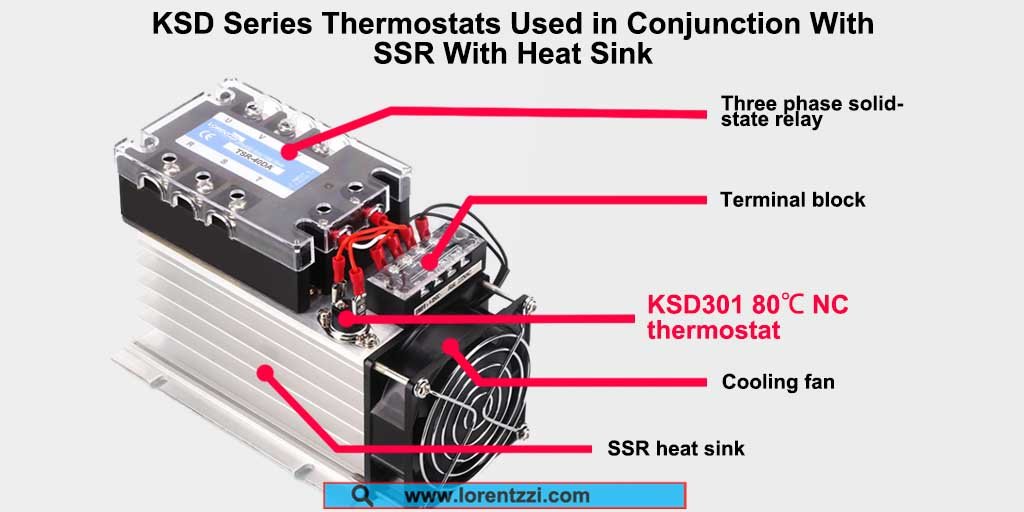
For example, if you want to cut off the power when the temperature exceeds 80 degrees Celsius (e.g., by installing these KSD301, KSD302 or KSD303 temperature control switch on our SSR heatsink to cut off the power when the temperature exceeds 80 degrees Celsius, thus protecting the SSR from overheating damage), you should choose the normally closed type KSD301, KSD302 or KSD303 with a temperature range of 80 degrees Celsius.
2. Select output type
KSD series temperature control switches can be divided into normally closed and normally open types. Normally closed types are typically used for over-temperature protection, while normally open types are commonly used for temperature-activated fan start-up, alarms, etc.
3. Determine the reset method
Typically, KSD301, KSD302, and KSD303 temperature cut-off switches come with an automatic reset function by default, meaning they will automatically close or open the contacts when the temperature is above or below the set value. If you require a non-reset thermostat, please consult your supplier.
Step 2: Installation of the KSD301, KSD302 and KSD303 thermostats
As you can see, the metal round surface of the KSD series thermostat is the temperature sensor.
This metal round surface must be in close contact with the heating surface and secured firmly with two M4 screws.
Furthermore, a thin layer of thermal grease needs to be applied between the contact surface and the heating object to reduce air gaps for accurate temperature sensing.

Step 3: Wiring of the KSD301, KSD302 and KSD303 thermostats
The KSD series thermostat has only two terminals with no polarity distinction, allowing it to be connected in series in a circuit. It is recommended to connect it in series with the live wire (220V) of the heating load.
The following is a typical and simple wiring diagram (when wiring, some protective devices should be used, such as MCB(Miniature Circuit Breaker) or RCBO(Residual Current Breaker with Over-Current)):
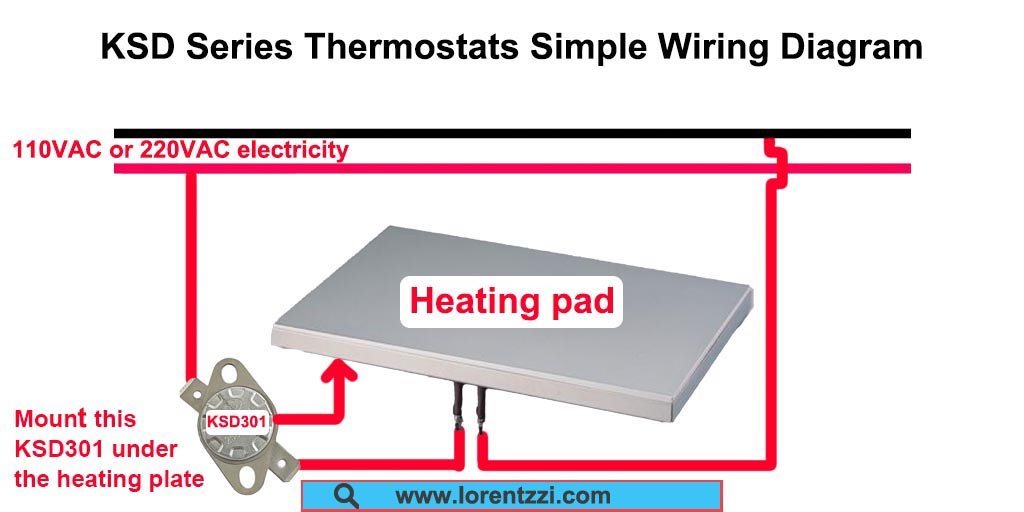
Note: The load current must not exceed the rated current of the thermostat. For high-power heating (e.g., exceeding 3.5kW), it is best to use a KSD301 to control a solid-state relay or AC contactor; never directly power high-current heating elements.
Step 4: Trial operation, long-term use and maintenance
After completing the first 3 steps, you can proceed with trial operation, long-term operation, and routine maintenance.
First, briefly connect the circuit power to verify its functionality. For example, if you have selected a normally closed 80°C KSD301 thermostat and want it to protect your solid-state relay (SSR) from overheating, during the trial operation, heat the KSD301’s metal temperature sensor to 80°C and check if it cuts off the SSR’s control signal. If the SSR’s power is immediately interrupted, the KSD301 is working correctly. Otherwise, carefully check the wiring or confirm if the thermostat is faulty.
After successful testing, the system can be put into long-term use. Please perform regular maintenance, such as checking its operation every three months.
Typical applications of KSD301, KSD302 and KSD303 thermostats
KSD301, KSD302 and KSD303 bi-metal thermal protectors are widely used in heating equipment due to their ease of use, and can also be used in motors, transformers, etc. to prevent overheating failures.
You can read the following to learn more about the devices that can be used with the KSD301, KSD302, and KSD303 bi-metal thermal protectors:
- Electric heating appliances: Electric water heaters, electric kettles, coffee makers, water dispensers, hot water taps, steam irons.
- Heating pads & heating films: PI heating films, silicone heating pads, bed heaters, foot warmers.
- Small household heating equipment: Electric ovens, air fryers, electric grills, towel racks, bathroom heaters.
- Motors & transformers overheat protection: Small motors, fan motors, power transformers, battery packs, charging modules.
- Industrial small heating assemblies: Industrial heating plates, small heating moulds, cabinet auxiliary heaters, thermostat heating units.
- Other equipment: Dehumidifiers, humidifiers, sterilizers, dish dryers, yogurt machines.
Conclusion
In short, the KSD301, KSD302, and KSD303 are simple bi-metal thermal protectors that are easy to install and widely used in heating control.
Whether you want to maintain a constant temperature or protect other equipment from overheating damage, the KSD301, KSD302, and KSD303 thermostats can help you.
If you would like to learn more about the KSD301, KSD302, and KSD303 bi-metal thermal protectors, please contact us, Lorentzzi Electric, for more information!