As a novice, do you have any difficulties in purchasing and choosing a suitable safety light curtain for your equipment?
You are not alone.
As a professional safety light curtain supplier in China, many people face this problem during our service process.
Therefore, in order to better solve this problem for novices, this tutorial will be divided into 8 steps to teach you how to choose a safety light curtain perfectly.
Step 1: Choosing the right beam pitch
A safety light curtain consists of multiple beams of direct light between a transmitter and a receiver, and detects the presence of an object by whether the light is blocked or not.
Beam pitch refers to the distance between two adjacent beams; it is sometimes also called resolution.
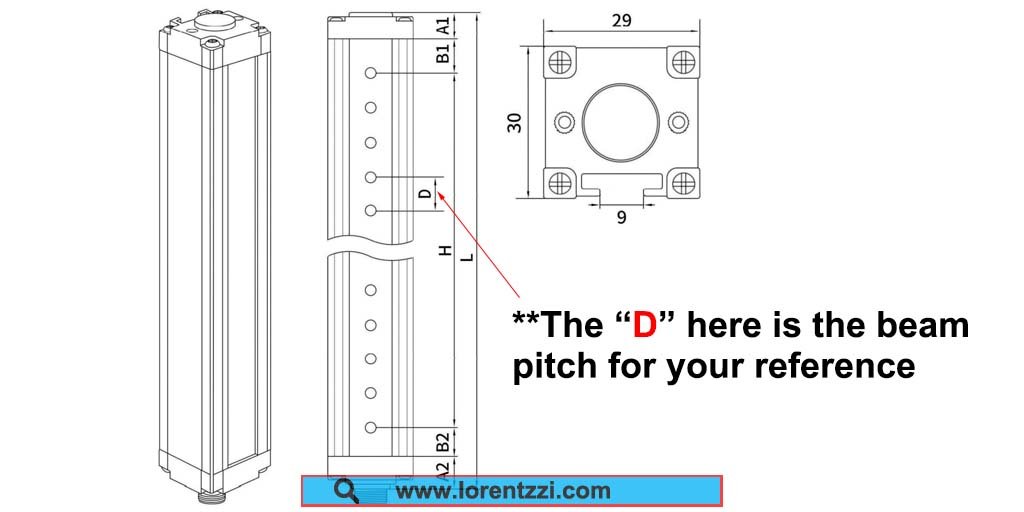
Lorentzzi safety light curtains are available in three main sizes: 10 mm, 20 mm, and 40 mm. 10 mm safety light curtains are primarily used to protect fingers from dangerous equipment, 20 mm are designed for hand protection, and 40 mm are used for body protection.
Therefore, you first need to determine which part of the body you want to protect. If the beam pitch is too small, protecting the same height will be too costly; if the beam pitch is too large, the desired protective effect may not be achieved.
Step 2: Decide the protective height
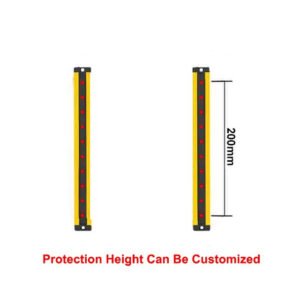
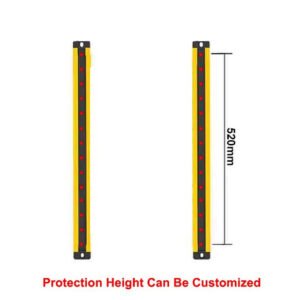
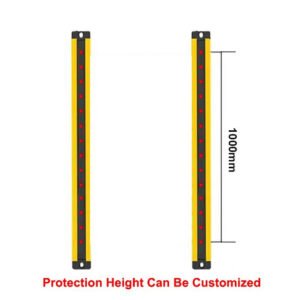
The protective height is the height that can be covered by safety curtain light beams.
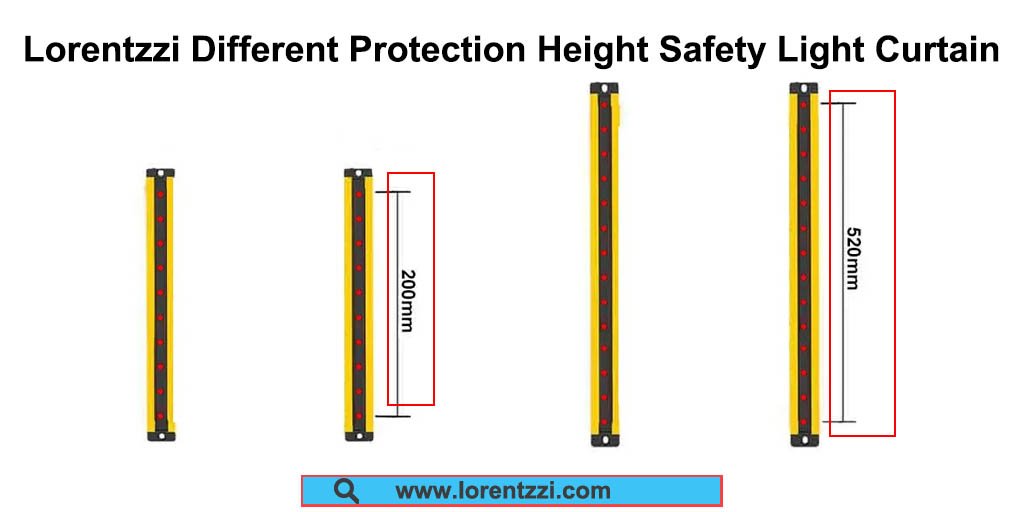
For instance, you have chosen the 10 mm beam pitch already, the protection height can be calculated by this formula: protection height= (beam quantity-1)*beam pitch, if your beam quantity is 8 pieces, so the protection height will be (8-1)*10=70 mm by the previous formula.
Choosing the appropriate guard height can effectively protect workers from danger and avoid potential unprotected areas.
Step 3: Confirm the total height of the safety light curtain
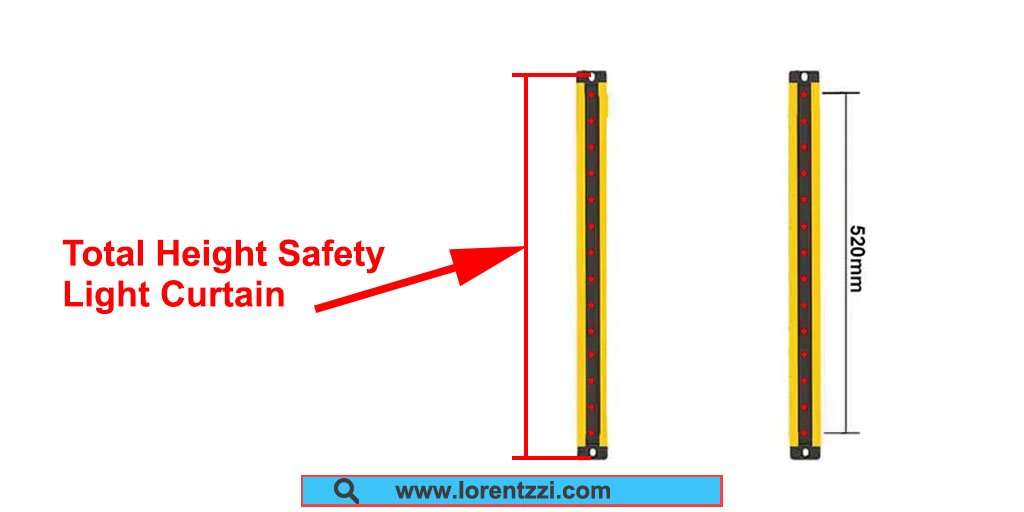
Why do we need to confirm the total height of the safety light curtain? The reason is obvious: if your installation height is limited and the safety light curtain you purchase is too long, installation will be very difficult.
Besides blind-spot-free safety light curtains, the total height of commonly used safety light curtains generally includes the height of the top cover and the height of the bottom cover.
Therefore, the total height of a safety light curtain = protection height mentioned before + top cover height + bottom cover height.
Carefully checking the total height of a safety light curtain before purchasing can help avoid installation problems.
Step 4: Confirm the protection width
The protection width of a safety light curtain refers to the maximum sensing distance between the light curtain transmitter and receiver.
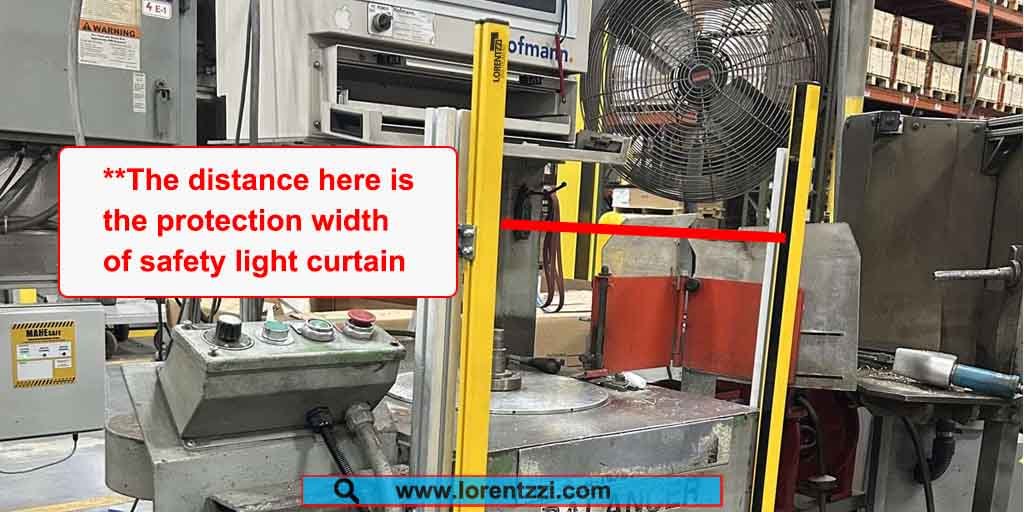
For example, if you install the transmitter on one side of the equipment’s material inlet window and install the receiver on the other side, the distance between them is the protection width.
Therefore, you need to measure the width of your equipment’s inlet and then select a safety light curtain with an appropriate protection width.
Please ensure that the protection width of the safety light curtain is greater than the width of the equipment’s feed inlet.
Our safety light curtains are available in widths of 0.1-5 meters, 0.1-10 meters, 0.1-15 meters, and 0.1-20 meters.
Step 5: Decide the synchronous mode
All safety light curtains on the market offer two synchronization modes: line synchronization and optical synchronization.
Line synchronization uses cables to synchronize the clocks of the transmitter and receiver. Optical synchronization, on the other hand, uses light to synchronize the clock.
Comparing these two modes, line synchronization is more reliable than optical synchronization, but it requires more cables to connect the transmitter and receiver; optical synchronization requires no cables, making it more convenient to use, but it has weaker noise immunity and is more susceptible to strong external light.
Therefore, if you intend to install the safety light curtain near equipment with high electromagnetic interference, such as frequency converters, or in a strong light environment, please choose line synchronization.
Step 6: Choose the output
When selecting a safety light curtain, output is another important factor to consider.
In terms of dry and wet contacts, the output can be a transistor PNP or NPN output, or a relay dry contact output.
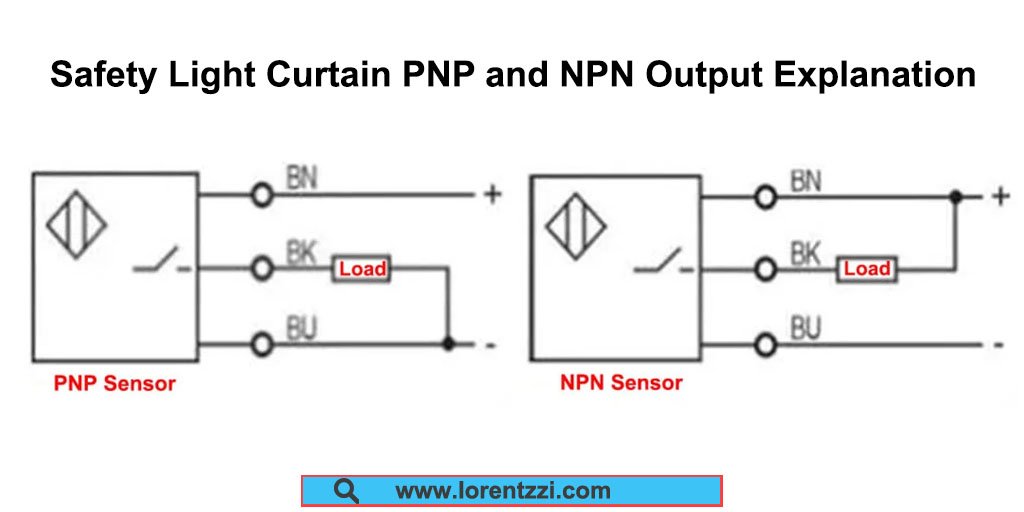
For faster response times, choose NPN or PNP transistor outputs; for higher load capacity, use relay outputs.
In terms of output channels, safety light curtains can be divided into single-output and dual-output types.
Dual-output safety light curtains provide enhanced safety for operators, meaning that if one output fails, the other can still function effectively.
Step 7: Check the installation method
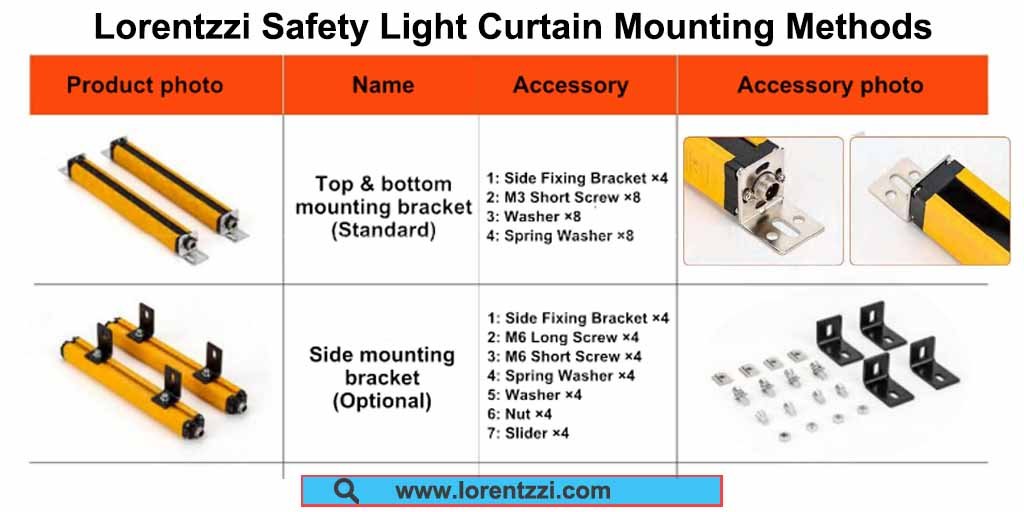
Lorentzzi’s safety light curtain product line offers two installation methods: side mounting and top/bottom mounting.
Each method has its advantages and disadvantages.
Side mounting is suitable for locations with ample space on both sides of openings in equipment such as machine tools, presses, and robotic workstations. The transmitter and receiver are located on opposite sides of the opening, with the beams aligned horizontally to form a vertical protective light curtain, completely blocking the intrusion path of personnel’s hands and limbs. It is important to note that in vibration environments, the beam alignment needs to be checked periodically.
Top/bottom-mounted systems place the transmitter and receiver at the top and bottom of the protected area, respectively. The beams propagate vertically, forming a horizontal protective light curtain, suitable for assembly lines and conveyor channels where space on both sides of the equipment is limited.
Therefore, before purchasing a safety light curtain, please check and confirm which installation method your equipment supports.
Step 8: Check whether need light curtain safety relay or not
In simple equipment systems, specific tasks are typically accomplished by hardware, eliminating the need for a PLC. Therefore, a safety relay is usually required for the safe use of light curtains in these systems.
Light curtain safety relays can control machine pause without PLC programming. Simply connect the safety light curtain to the safety relay to achieve functions such as machine pause, manual reset, and mute.
If you are a professional engineer capable of easily implementing control using PLC programming, a safety relay is generally unnecessary. You can simply use the PLC to receive the signal from the safety light curtain and write the corresponding program to the PLC to achieve complex functions such as pause and reset.
The final result you can achieve
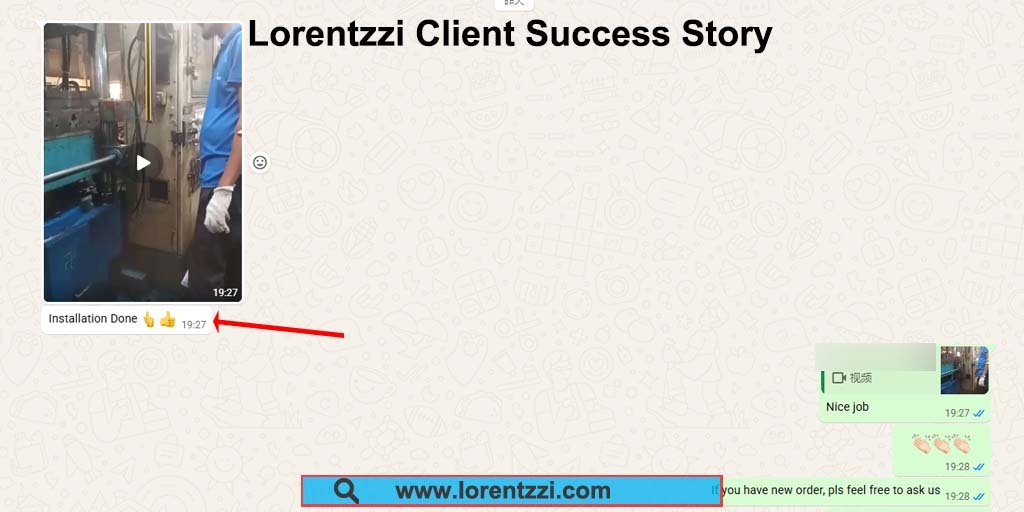
Finally, you can see the results shown in the video below: when the safety light curtain is blocked, the machine can stop running immediately, thus effectively protecting your workers from potential injury.
Conclusion
After completing the above 8 steps, you should now have a clear understanding of how to choose the right safety light curtain for your equipment.
If you still have questions about product selection, or are looking for a reliable partner to provide you with reasonably priced and consistently high-quality safety light curtains, please contact us for further support.
Let’s work together!