

Today, we will introduce the usage of foot pedal switches. Foot pedal switches are widely used in medical equipment, stamping machines, welding equipment, textile machinery, and printing machinery.
In the electronics industry, they are utilized in applications such as small robots and terminal machines, with options for automatic and inching operations using foot switches. By stepping on the foot switch, a certain action or operation is triggered.
What is a foot switch?
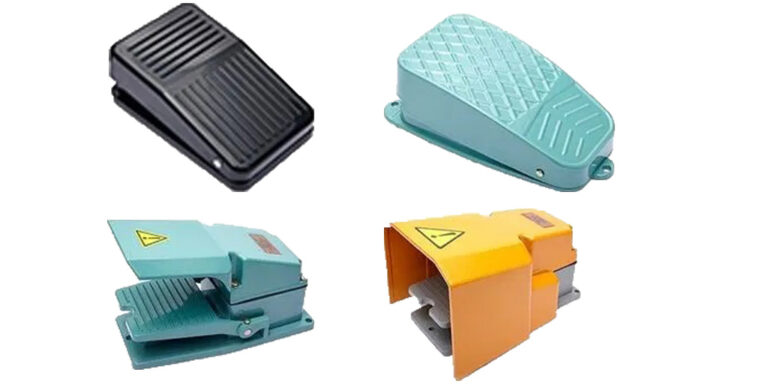
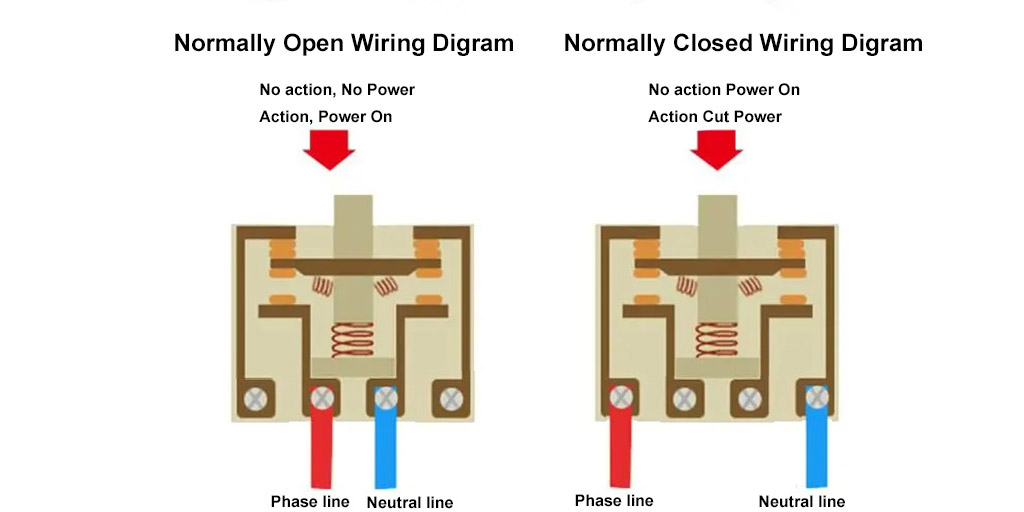
A footswitch is a switch that is pressed by the foot to turn on and off the controlled circuit. Its working principle is the same as that of a limit switch. When external pressure is applied, the contact moves and the circuit changes from normally open to normally closed or from normally closed to normally open. Generally a foot pedal switch has two ways, one is NO contact, the other is NC contact, it is a 2 way foot pedal switch.
The internal structure of a foot pedal switch
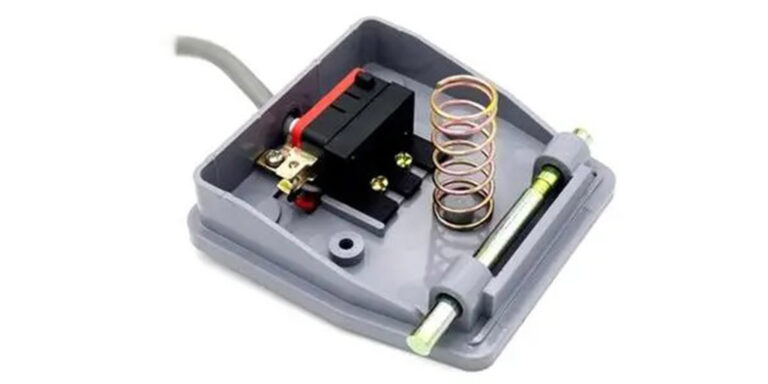
The internal structure of a foot switch consists of two sets of contacts: normally open and normally closed. When we step on the foot switch, the normally open contacts close, similar to a start button being pressed. The normally closed contacts open, resembling a stop button being pressed.
Wiring diagram of foot switch and a motor
To control a motor using a foot switch, the main circuit breaker is connected to the three-phase contactor main contacts, and the contactor output is connected to the motor. The control circuit includes the contactor coil A1, which is connected in parallel with one wire from the contactor, and another wire is connected from the circuit breaker to the single-pole (SP) input of the foot switch. The output of the normally open contacts of the foot switch is connected to the contactor coil A2.

Conclusion
In conclusion, the foot switch is a versatile and widely used device in various industries, including medical equipment, stamping machines, welding equipment, textile machinery, and printing machinery.
It is also commonly used in the electronics industry for applications such as small robots and terminal machines.
By stepping on the foot switch, specific actions or operations can be triggered.
The foot switch is designed with both normally open and normally closed contacts, which provide flexibility for different control scenarios. It is commonly used to control motors, with the main circuit breaker connected to the contactor and the foot switch serving as a control input.
Overall, the foot switch plays a crucial role in providing convenient and hands-free control in various industrial applications.