Inductive proximity sensors can detect metallic objects, but identifying different types of metallic objects is another matter.
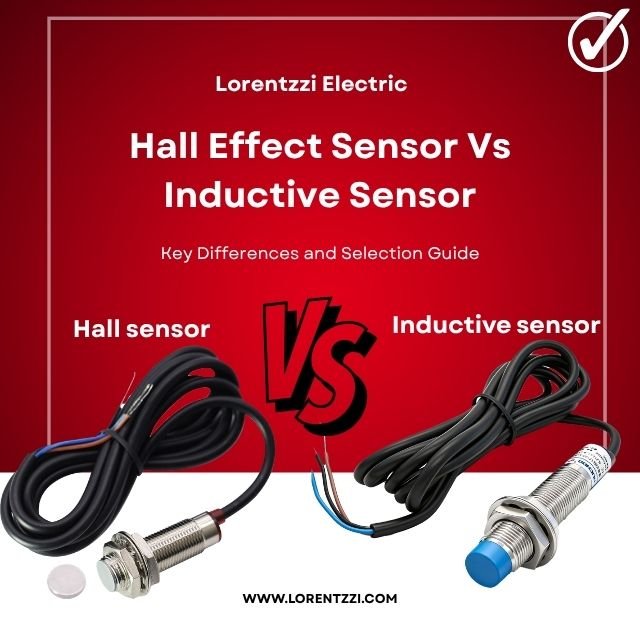
Let’s look at how to distinguish between metallic and magnetic objects. The answer and solution is simple: you can use the inductive proximity sensor to detect metallic objects, while you can use the Hall effect sensors to only detect magnetic objects.
However, do you know the main differences between these two types of sensors and how to choose between them? In this blog post, we’ll provide you with detailed information and a selection guide.
Now, let’s delve deeper.
What is a Hall effect sensor?
Hall effect sensors detect objects by sensing changes in magnetic fields relying on the Hall effect. You can think of them as highly magnetically sensitive detectors, and they are widely used to sense magnetic fields, magnetic objects, and related position or motion parameters.
Compared to incremental rotary encoders, Hall effect sensors offer a more economical and practical method for motor speed detection. Accurate and stable speed measurement can be achieved simply by mounting a magnet on the motor shaft or gear within the sensing range of the Hall sensor.
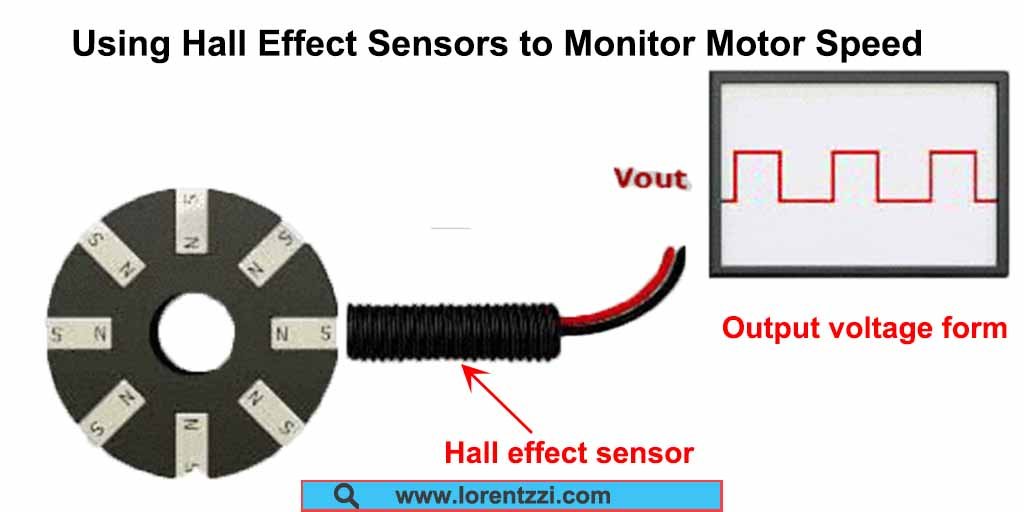
Furthermore, Hall effect sensors are well-suited for cylinder position detection. Because cylinders are completely sealed and made of metal, inductive proximity sensors cannot directly observe and detect the position and frequency of the internal piston. Reliable position and frequency detection can be achieved by mounting a Hall effect sensor with a magnetic ring externally to the cylinder.
What is an inductive proximity sensor?
Now let’s have a look at the inductive proximity sensor.
Inductive proximity sensors are non-contact devices specifically designed to detect metallic targets, including iron, stainless steel, copper, and brass. When metal enters its sensing range, eddy currents are generated, which suppress the sensor’s oscillating field and activate the output.. You can learn more from our blog post: The Inductive Sensors Working Principle And Applications.
The Inductive proximity sensors are widely used in industrial automation and are commonly used for position detection, displacement detection, and other applications.
Key differences between Hall effect sensor and inductive sensor
The main differences between Hall effect sensors and inductive sensors lie in the following 4 aspects: sensing objects, working principles, prices, applications.
You can view the detailed differences in the comparison table below:
| Item | Hall effect sensor | Inductive sensor |
|---|---|---|
|
Sensing objects |
Detects magnets or other magnetic objects; it is not sensitive to other types of objects. |
Various metallic objects, including magnets, brass items, stainless steel items, aluminum items, etc. |
|
Working principle |
Based on the Hall effect: when a magnetic field passes through the internal Hall element, charge deflection occurs, forming a Hall voltage. This voltage is amplified and shaped to output a switching signal. |
Based on the eddy current effect: the internal high-frequency oscillation circuit generates an electromagnetic field; when a metal object approaches, eddy currents are induced on the metal surface, thereby attenuating the oscillation energy and triggering the output circuit. |
|
Price |
Around USD10.0 or below, generally lower than the inductive proximity sensor |
Generally below USD20.0, a little expensive than the Hall effect sensor |
|
Application |
Motor speed detection, cylinder position detection, magnetic field measurement, and non-metallic object detection (with magnetic ring). |
Industrial automation of metal position detection, workpiece counting, limit control and origin positioning. |
Selection guide
Here below our tips for your selection between the Hall sensor and inductive sensor:
- If your sensing target is in an environment containing multiple metal objects, and you want to accurately detect a specific target, such as monitoring the speed of a metal gear, it is recommended to use a Hall sensor and attach a magnet to the teeth of the gear.
- If you need to detect all metal objects, such as counting all the metal parts produced on a conveyor belt, an inductive sensor is more recommended.
Conclusion
In short, the main difference between Hall effect sensors and inductive sensors is that Hall effect sensors can only sense magnets, while inductive sensors can sense not only magnets but also other metallic objects. Both types of products are widely used in industrial control.
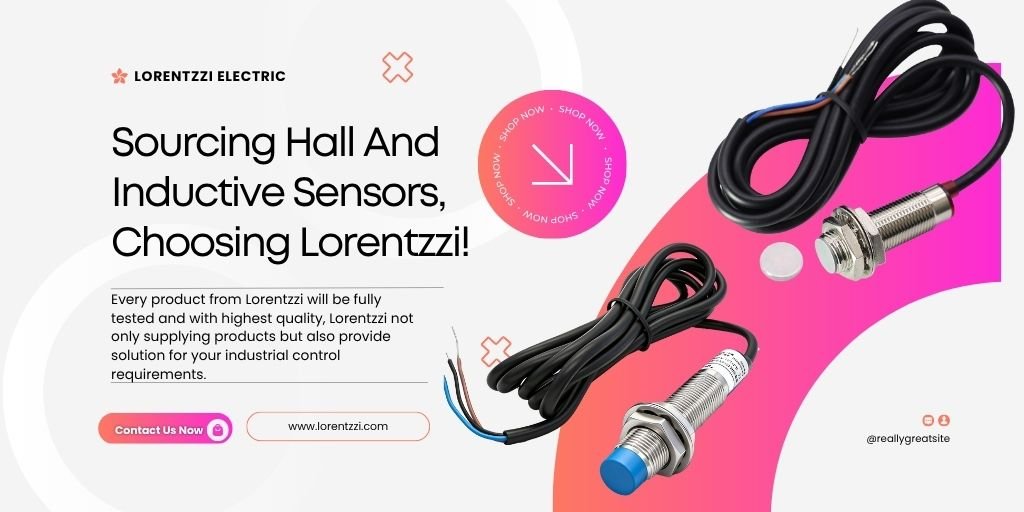
If you are looking for a reliable Hall sensor and inductive sensor supplier from China, or seeking professional advice, you can send your inquiry or technical questions to shonxu@lorentzzi.com. The Lorentzzi team is happy to support you.